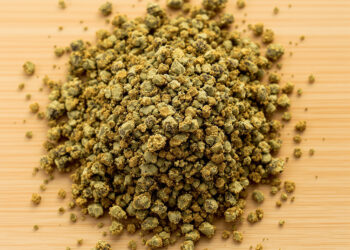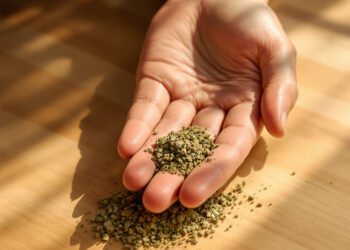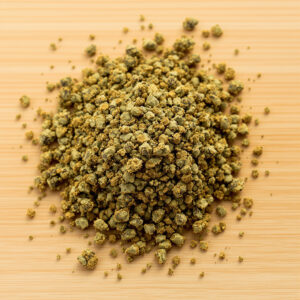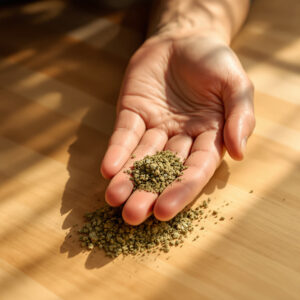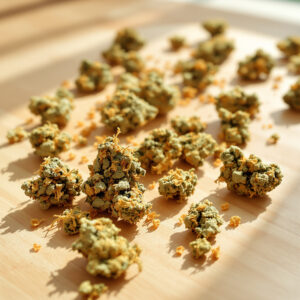
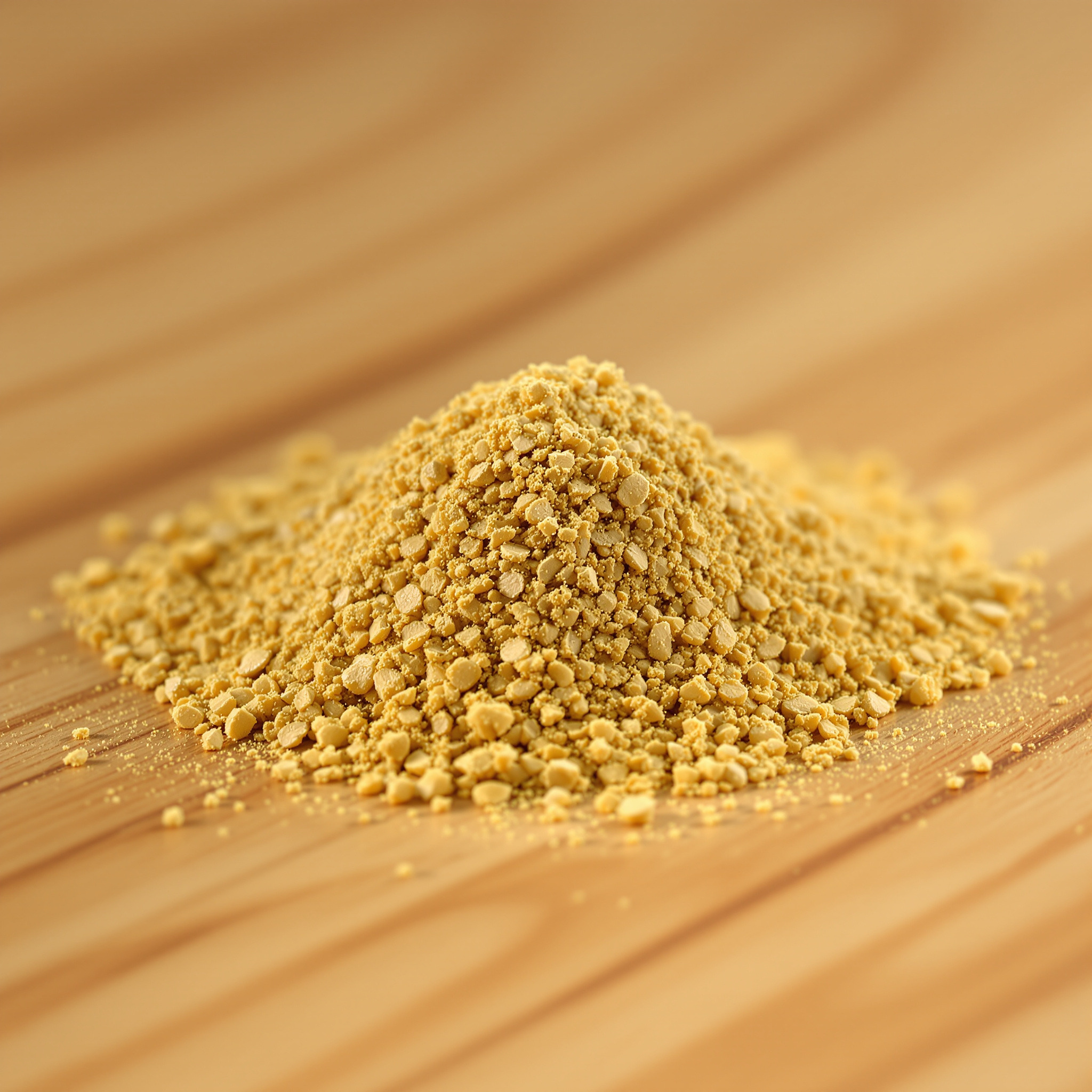
Kief is the fine, light powder that accumulates in the bottom chamber of a four-piece grinder. These are broken-off trichomes—the very glands where cannabinoids and terpenes are housed. Because kief is significantly more concentrated than the flower it comes from, it’s worth keeping rather than discarding. Here’s how it gets into that chamber, how to get more of it, and what you can do with it.
📑 Inhaltsverzeichnis
How the Screen and Kief Chamber Work Together
A four-piece grinder consists of a lid, grinding chamber, collection chamber, and below that, the kief chamber. Between the collection and kief chambers sits a fine mesh screen.
When grinding, trichomes break off from the flower surface. They are smaller and heavier than plant material and fall through the mesh openings, while the ground material stays on top. This is the entire mechanism, and it also explains why two- and three-piece grinders don’t collect kief: without a screen, it remains in the material and gets consumed together with it. It’s not lost—it’s just not separated.


Why Some Kief Chambers Stay Empty
An empty kief chamber almost always has one of four reasons.
- It’s not being shaken. Trichomes don’t fall through the screen on their own. A quick shake with the lid closed after every grind produces better results than anything else.
- The material is too moist. Trichomes only break off when they’re brittle enough. Fresh, sticky flower produces little kief and instead gums up the teeth.
- The screen is clogged. A layer of resin on the mesh blocks the openings. This happens especially if the grinder is reassembled while damp after cleaning.
- It just takes time. After two or three grinds, don’t expect anything visible. A usable amount accumulates over weeks.
What Affects Your Yield
Part of this is in your hands, part is built into your device.
Mesh Fineness
The finer the mesh, the purer the kief, since only the tiniest particles pass through. The coarser the mesh, the greater the quantity, but with more plant material mixed in. This is a trade-off, not a quality issue with the manufacturer—both have merit depending on whether you prioritize purity or volume. Some grinders offer interchangeable screens with different mesh sizes.
Grinding Chamber Surface
Smooth and non-stick surfaces allow fewer trichomes to stick, so more falls through. Rough surfaces—like wood or poorly finished metal casting—cause a larger portion to cling to the walls. It’s not lost, but it ends up on a cleaning cloth rather than in the chamber.
Tooth Shape
Sharp, diamond-shaped teeth grind more thoroughly and release more trichomes than blunt or worn teeth. This is an indirect effect: the tooth shape itself doesn’t collect kief, but a finer grinding result does.
How Fine You Grind
Finer grinding releases more trichomes. This isn’t a license to over-grind, though, because material ground too fine restricts airflow. Those specifically after kief should grind normally and shake consistently instead.
How Potent Is Kief
Significantly stronger than the flower it comes from, since it consists mainly of the plant part that carries the active compounds. We deliberately don’t provide a specific number: the content depends on the starting flower, mesh fineness, and how much plant material fell through with it. Most values found online have no measurement method backing them.
In practice, this means kief is dosed differently than flower. A knife tip’s worth sprinkled on a joint is a noticeable enhancement; a spoonful is not. Those using kief for the first time should reasonably start with very little and wait before adding more.
What You Can Do With Kief
- Sprinkle over ground material. The simplest method. Add some kief to ground material in a joint, pipe, or bong.
- In a vaporizer. It works, but not loose: pure kief falls through the screens and burns in spots. Either mix it with flower or use a dosing capsule.
- Press into hash. With pressure and gentle heat, kief can be pressed into a solid mass. Small pollen presses exist for this, but parchment paper and patience work too.
- For edibles. An extra step is needed here: without prior heating, most active compounds remain in acid form and have little oral effect. Those processing kief into butter or oil should first learn about decarboxylation.
Storing Kief Properly
Kief is more delicate than flower because the trichomes are already separated and exposed to air. Terpenes evaporate faster, and light speeds degradation.
If you accumulate larger amounts, remove it from the grinder and store it in a small, airtight container in a dark, cool place. Left in the chamber, kief is exposed to air and light every time you open the grinder, and it gradually adheres to the walls.
Frequently Asked Questions
How long does it take to collect a usable amount?
It depends entirely on how much you grind and how dry your material is. A visible layer typically requires several weeks of regular use. If you check after a week and find nothing, you’re not doing anything wrong.
Can I harvest kief from a grinder without a kief chamber?
Not during grinding, but afterward. Separate screens and sift boxes exist that you shake ground material through. It’s the same mechanism, just outside the grinder.
What’s the difference between kief and hash?
Kief is loose trichome powder. Hash forms when you press it, causing the glands to rupture and fuse into a cohesive mass. The starting material is identical; the form differs.
My kief is greenish instead of light-colored. Is that bad?
It means a lot of plant material fell through, usually due to a coarser screen or grinding too long. It’s not bad—just less concentrated and tastes more herbal.
Can I add the resin from the lid to my kief?
Yes. What you can scrape from the lid and teeth is the same material, just compressed. It’s darker and stickier than fresh kief and presses in easily with the rest.
More About Grinders










Sammelst du das Kief aus deinem Grinder?
Branchen-Update
News, Analysen und Reportagen — mehrmals im Monat direkt in dein Postfach.
Folge uns