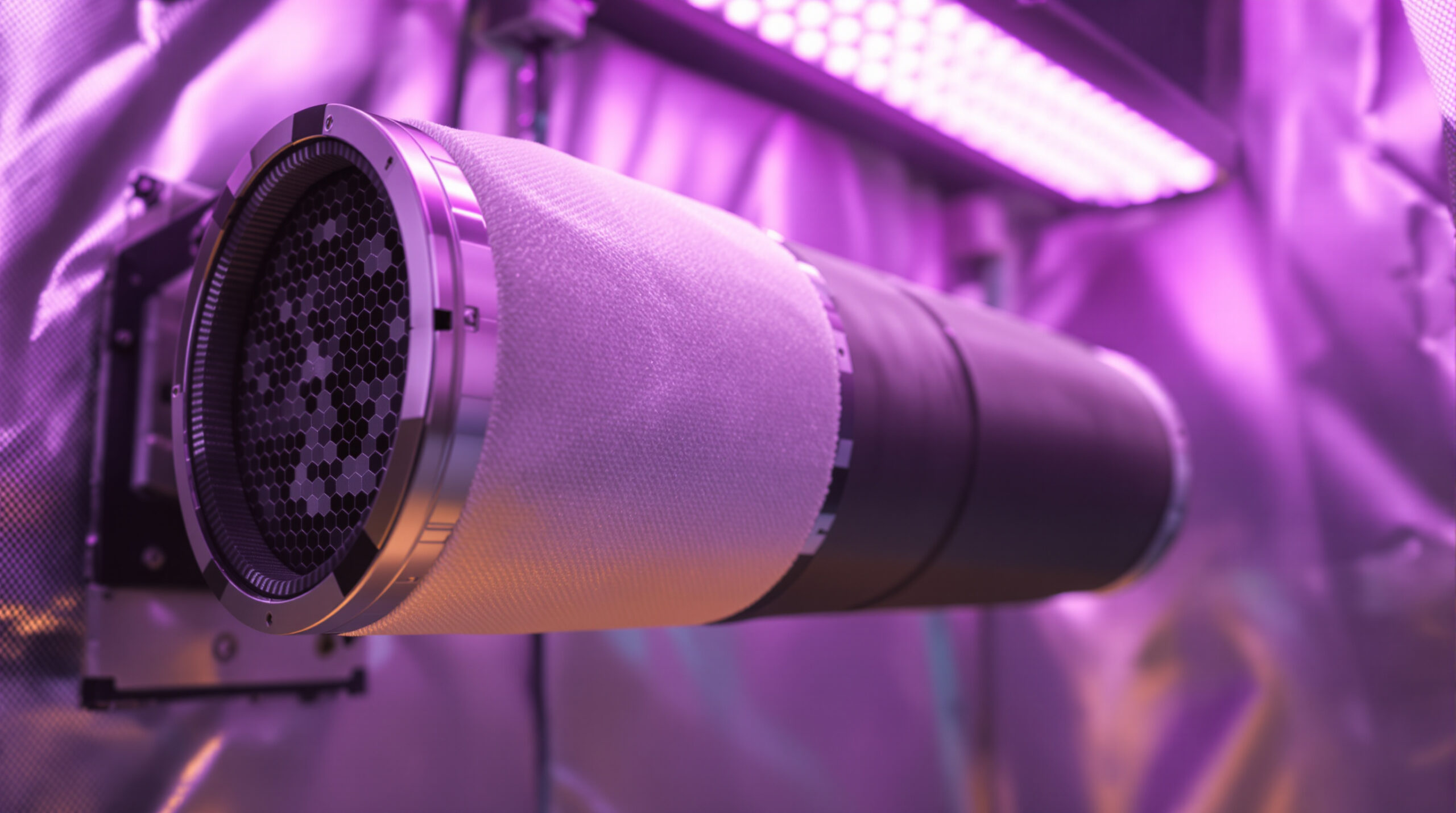
Exhaust air is the most inconspicuous component in the grow room and simultaneously the one that determines success or frustration. It carries heat and moisture outside, it supplies plants with fresh CO2, and it keeps odors where they belong. Anyone who buys a fan on a whim will notice the consequences by the third week of flowering at the latest. Temperature climbs, the activated carbon filter can no longer keep up, and suddenly a sweet aroma lingers in the stairwell. The good news: Sizing is pure mathematics and takes ten minutes.
📑 Inhaltsverzeichnis
- Why exhaust air in the grow room is about more than just odor
- Calculating grow box exhaust: the formula for airflow
- The activated carbon filter must match the fan, not the other way around
- Fresh air intake, negative pressure, and circulation working together
- Climate values per phase: what the system must deliver
- Quiet ventilation without performance loss
- Frequently asked questions
- 💬 Fragen? Frag den Hanf-Buddy!
Why exhaust air in the grow room is about more than just odor
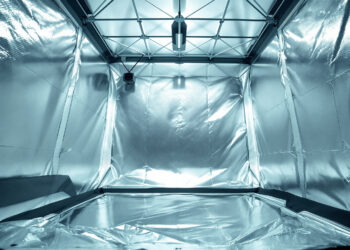
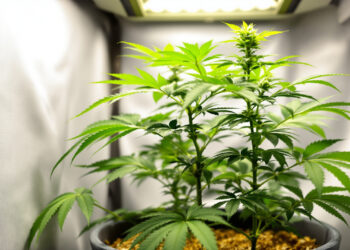
A grow box is a closed space where a lamp permanently emits heat and multiple plants continuously evaporate water. Without continuous air exchange, temperature rises, relative humidity climbs with it, and CO2 levels drop below what photosynthesis needs. Plants then visibly slow their growth, even though light, nutrients, and substrate are correct.
The exhaust system therefore performs three tasks simultaneously. It removes waste heat, it lowers relative humidity and thus prevents mold on flowers, and it draws room air through the activated carbon filter. Only the third task has to do with discretion. The first two determine yield. Those focused exclusively on odor will find practical tips in our article on odor control in indoor cultivation. Here we cover the technology behind it.


Calculating grow box exhaust: the formula for airflow
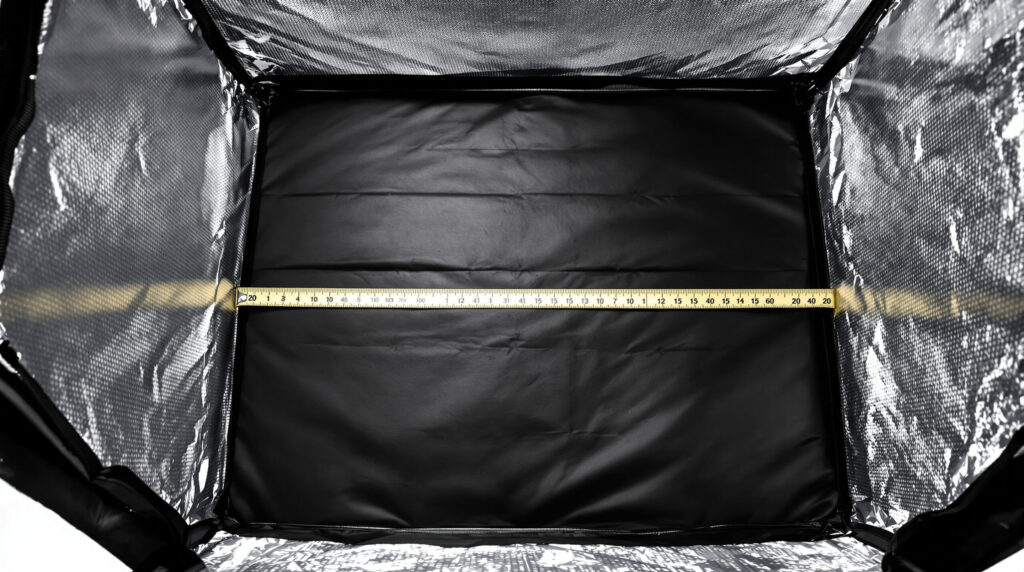
The starting point is the box volume in cubic meters. Length, width, and height are multiplied in meters. A standard 120cm box with 120 by 120 by 200 centimeters therefore equals 1.2 times 1.2 times 2.0, resulting in 2.88 cubic meters. This volume is multiplied by 60. The result is the baseline value in cubic meters per hour and corresponds to complete air exchange roughly every minute. For our 120cm box, that’s around 173 cubic meters per hour.
This baseline value applies, however, to a fan that exhausts freely. In practice, an activated carbon filter, several meters of ductwork, and typically two to three elbows are attached. Each component creates pressure loss. As a rule of thumb, the filter accounts for roughly 35 percent surcharge, and each meter of duct and each additional elbow adds further reserve. Overall, a 30 to 50 percent surcharge on the baseline value is appropriate. From 173 cubic meters per hour, this becomes roughly 260.
| Grow Box | Volume | Baseline (Volume × 60) | Recommendation with Filter and Duct |
|---|---|---|---|
| 60 × 60 × 160 cm | 0.58 m³ | approx. 35 m³/h | approx. 50 to 60 m³/h |
| 80 × 80 × 180 cm | 1.15 m³ | approx. 70 m³/h | approx. 100 to 110 m³/h |
| 100 × 100 × 200 cm | 2.00 m³ | approx. 120 m³/h | approx. 160 to 180 m³/h |
| 120 × 120 × 200 cm | 2.88 m³ | approx. 173 m³/h | approx. 230 to 260 m³/h |
| 150 × 150 × 200 cm | 4.50 m³ | approx. 270 m³/h | approx. 360 to 410 m³/h |
Those wavering between two fan sizes should choose the larger one. A powerful fan running at reduced speed is quieter and more durable than an undersized one working at full capacity continuously. Which box size actually suits your needs is clarified beforehand in our comparison of grow boxes or grow tents and appropriate equipment.
The activated carbon filter must match the fan, not the other way around
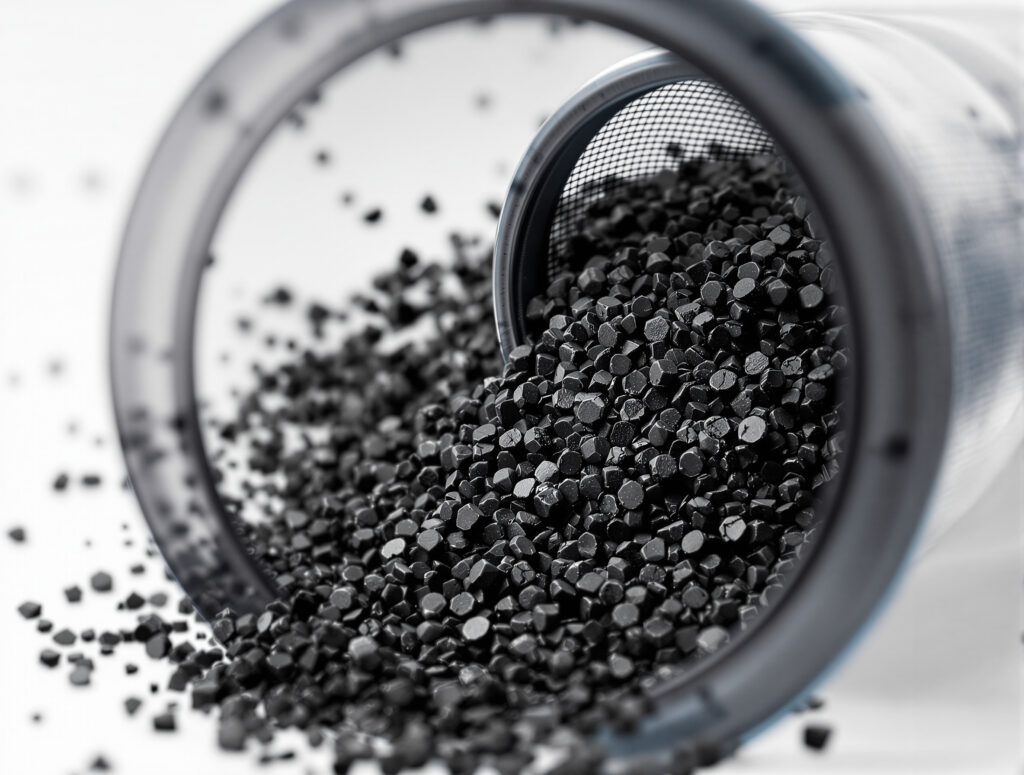
The most common planning mistake is a filter rated weaker than the fan in front of it. The rated capacity of the activated carbon filter must at minimum match the fan’s airflow, ideally 20 to 30 percent higher. If the filter is too small, the fan forces air through the carbon layer faster than it can bind odor molecules. The result is a filter that looks good on paper and leaks in practice.
Service life depends heavily on conditions and ranges between six months and two years depending on quality and load. The most important influencing factor is humidity. Activated carbon works most reliably below 55 percent relative humidity. Above about 60 percent, binding performance noticeably decreases, and above 70 percent, reliable odor filtration is no longer possible. A filter hanging in a constantly humid box therefore ages significantly faster than the datasheet promises.
Practically, this means two things. First, the prefilter—that usually white fleece around the filter body—should be removed and rinsed every two to three months. Dust otherwise clogs the intake area and reduces throughput. Second, the filter should sit at the highest point inside the box, because that’s where the warmest and most odor-intensive air is. Whether more expensive models are worthwhile is examined in our activated carbon filter test.
Fresh air intake, negative pressure, and circulation working together
An exhaust system only works when air can flow in to replace it. The simplest variant is passive fresh air intake through openings in the lower area of the box. In total, these openings should be larger than the exhaust outlet, but not so generous that negative pressure is lost. Cold fresh air flows in near ground level, warms up around the plants, and is sucked out at the top. For larger tents or long intake paths, an active fresh air fan helps. Its performance must remain below that of the exhaust fan, otherwise negative pressure is lost.
Whether negative pressure is correct is revealed by looking at the tent walls. If they’re slightly drawn inward, the system is working correctly and all exhaust air takes the path through the filter. If walls bulge outward, unfiltered air escapes through every seam and cable opening. No filter, however good, can compensate for that.
Circulation fans inside the box are a third, independent component. They don’t exchange air, but rather break up the humid boundary layer directly at the leaves and strengthen stems as a bonus. They don’t replace exhaust fans, but without them moist pockets remain in the canopy. For those additionally wanting to work with air enrichment, find the fundamentals in the article on CO2 in indoor growing.
Climate values per phase: what the system must deliver
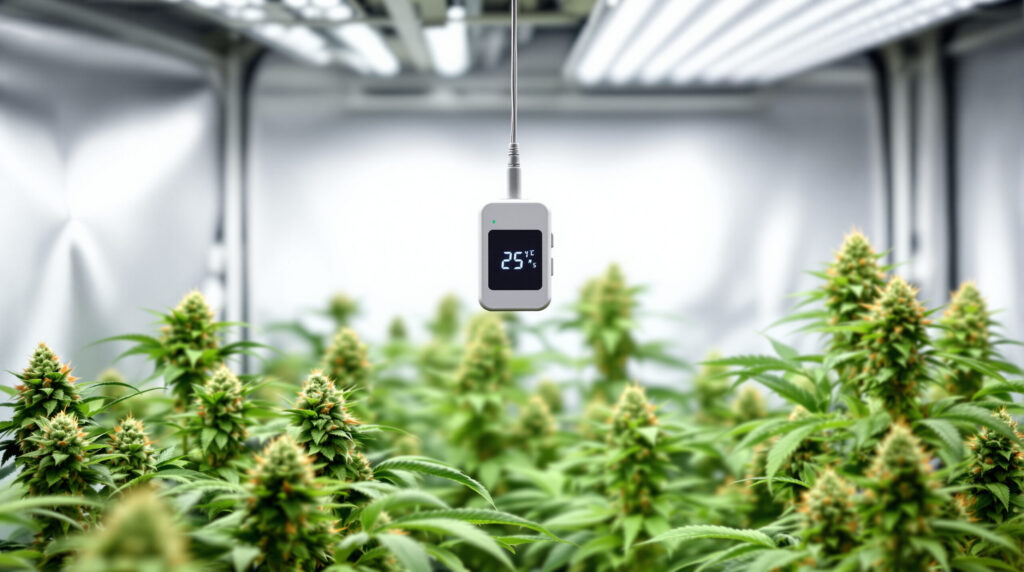
The correct fan performance ultimately results from the climate to be achieved. In the vegetative phase, plants thrive at 24 to 28 degrees with relative humidity of 50 to 70 percent. During flowering, both values drop; sensible targets are then 20 to 26 degrees and 40 to 50 percent. Night temperatures may fall to 18 to 22 degrees, but too large a gap from daytime values causes humidity to rise significantly.
More informative than either single value is vapor pressure deficit, or VPD. It describes how strongly air can extract water from plants and ideally lies between 0.8 and 1.2 kilopascals during the growth phase. During flowering, 1.2 to 1.6 kilopascals is the target range. The appropriate value for your own measurements is provided by our VPD calculator. Sensor position is important. It belongs at the height of flower tips, not at the tent wall, because very different values prevail there. Which other target values matter in the flower room is summarized in our article on climate conditions in the flower room.
Quiet ventilation without performance loss
Noise is a real issue in home growing, especially in rental apartments. The most effective lever is the aforementioned oversizing. An EC fan running at 40 to 60 percent speed is significantly quieter than a small model at full capacity and uses less electricity too. A silencer between fan and exhaust duct further removes noise and whistling from the system.
The rest is building physics. The fan shouldn’t hang rigidly on the wall or tent framework, but rather decoupled on rubber mounts so no sound bridges form. Insulated aluminum flex ducts absorb more noise than thin-walled ones, and generous bends are quieter than tight kinks. How to systematically reduce a system to whisper-quiet levels is shown in our earlier practical article on properly quiet exhaust ventilation in the grow room.
Frequently asked questions
How strong must the fan be for a 120cm grow box?
A box measuring 120 by 120 by 200 centimeters holds 2.88 cubic meters. The calculated baseline value is thus around 173 cubic meters per hour. With activated carbon filter, duct, and elbows, the fan should deliver approximately 230 to 260 cubic meters per hour. In practice, a 150mm inline fan with stepless control is most comfortable because it achieves the required performance in the lower speed range.
Should the activated carbon filter go inside or outside the box?
Both work, as long as the filter sits on the intake side and all exhaust air passes through it. Inside, it has the advantage of directly capturing the warmest air under the tent roof and taking up no room in the space. Outside, it’s easier to access and dampens operating noise less. In both cases, what matters is that there’s no loose connection between filter and fan.
How often must an activated carbon filter be replaced?
No universal value exists; six months to two years is typical. What matters is operating hours and humidity, as moist air significantly shortens service life. A simple test helps: if air exiting the duct end smells like plants, the carbon is exhausted. The prefilter, meanwhile, is not replaced but rather rinsed every two to three months and reattached dry.
Is passive fresh air intake enough or does it need an active fan?
For boxes up to about 120 by 120 centimeters, passive intake is usually sufficient if the lower openings are large enough. An active fresh air fan is worthwhile for larger tents, very long intake paths, or when fresh air is drawn from another room. Its performance must remain below exhaust performance to maintain negative pressure.
Must exhaust run at night?
Yes, though at reduced speed. During the dark phase, temperature drops and relative humidity consequently rises, which is exactly when mold risk on flowers develops. Completely shutting down for eight to twelve hours is therefore not a good idea. What makes sense is a controller that reduces the fan to about 40 to 50 percent at night instead of turning it off completely.
How do I know if my negative pressure is correct?
Wie dimensionierst du die Abluft für deine Growbox?
The tent walls are the best indicator. If they’re slightly drawn inward during operation, there’s negative pressure and all exhaust air takes the path through the filter. If walls bulge outward tautly, unfiltered air flows through seams and cable openings. Solutions include smaller fresh air openings, a reduced fresh air fan, or a stronger exhaust fan.








Branchen-Update
News, Analysen und Reportagen — mehrmals im Monat direkt in dein Postfach.
Folge uns