Cannabis oil for sleep disorders has been prescribed increasingly in German practices since the Cannabis as Medicine Act came into force in 2017, yet the question of efficacy, dosage, and actual benefit for mental health remains complex. Those who cannot wind down in the evening, lie awake at night, or are jolted from sleep by nightmares often seek an alternative to benzodiazepines, Z-drugs, and sedating antidepressants.
📑 Inhaltsverzeichnis
- How Cannabis Oil Works for Sleep Disorders: Endocannabinoid System and Sleep Architecture
- CBD Oil, THC Oil, or Full-Spectrum: Which Cannabis Oil Works Best?
- Dosing Cannabis Oil for Sleep Disorders: Start Low, Go Slow
- Cannabis Oil for Mental Health Issues Beyond Sleep: Anxiety, Depression, PTSD
- Risks, Side Effects, and Drug Interactions with Antidepressants
- Cannabis Oil on Prescription in Germany 2026: How Prescription Works
- Frequently Asked Questions
- 💬 Fragen? Frag den Hanf-Buddy!
Cannabinoid-containing drops promise a gentler approach that not only facilitates falling asleep but regulates the body’s entire sleep-wake system. The following guide compiles the current evidence, describes the mechanisms of action in the endocannabinoid system, explains the differences between CBD oil and medical cannabis oil containing THC, and provides key information on dosage, risks, and prescription in Germany in 2026.
How Cannabis Oil Works for Sleep Disorders: Endocannabinoid System and Sleep Architecture

The human sleep-wake system is controlled by a finely balanced network of neurotransmitters in which the body’s own endocannabinoid system plays a central role. CB1 receptors are present in high density in the hypothalamus, amygdala, and prefrontal cortex—precisely those brain regions that regulate circadian rhythms, emotional processing, and stress responses. Those suffering from chronic insomnia, sleep onset difficulties, or fragmented sleep often show dysregulation of this system. This is exactly where cannabis oil comes in: the contained cannabinoids dock onto CB1 and CB2 receptors, modulate the release of GABA and glutamate, and directly intervene in those circuits responsible for relaxation and sleep induction. More background on how this system works can be found in our detailed article on the endocannabinoid system.


Unlike classical sleep medications, cannabis oil does not sedate the central nervous system but rather shifts sleep architecture. THC measurably extends deep sleep phases in which body and immune system regenerate while simultaneously shortening REM sleep. This REM reduction is why many patients on THC-containing oil report fewer nightmares, an effect that is therapeutically utilized particularly in post-traumatic stress. CBD acts in the opposite direction and follows a U-shaped dose-response curve: low doses can even be slightly activating, while higher amounts unfold clearly calming and anxiolytic effects. The combination of both cannabinoids in a full-spectrum oil is therefore considered pharmacologically more sensible than isolated compounds because the effects round each other out and buffer side effects. This synergy effect is established in research as the entourage effect and explains why standardized full-spectrum extracts often work more powerfully than the sum of their individual parts.
The Australian Quod study, one of the largest real-world investigations into medical cannabis oil to date, showed statistically significant improvements in sleep quality, fatigue, and general quality of life over twelve months. Already after three months, participants reported more stable nights, and the effect persisted throughout the entire study year. A smaller placebo-controlled study with an evening dose of 10 mg THC and 15 mg CBD improved sleep quality measurably compared to placebo within two weeks. Average sleep duration increased by approximately 30 minutes per night. However, this data is not without shadows: a 2026 mega-review published in The Lancet Psychiatry covering over 50 randomized controlled studies found only weak or absent evidence for most psychiatric indications such as depression, generalized anxiety disorder, and PTSD, yet found a limited but positive signal precisely for insomnia. Cannabis oil for sleep disorders is thus one of the few mental health applications that holds up even after critical re-analysis of the study landscape.
CBD Oil, THC Oil, or Full-Spectrum: Which Cannabis Oil Works Best?
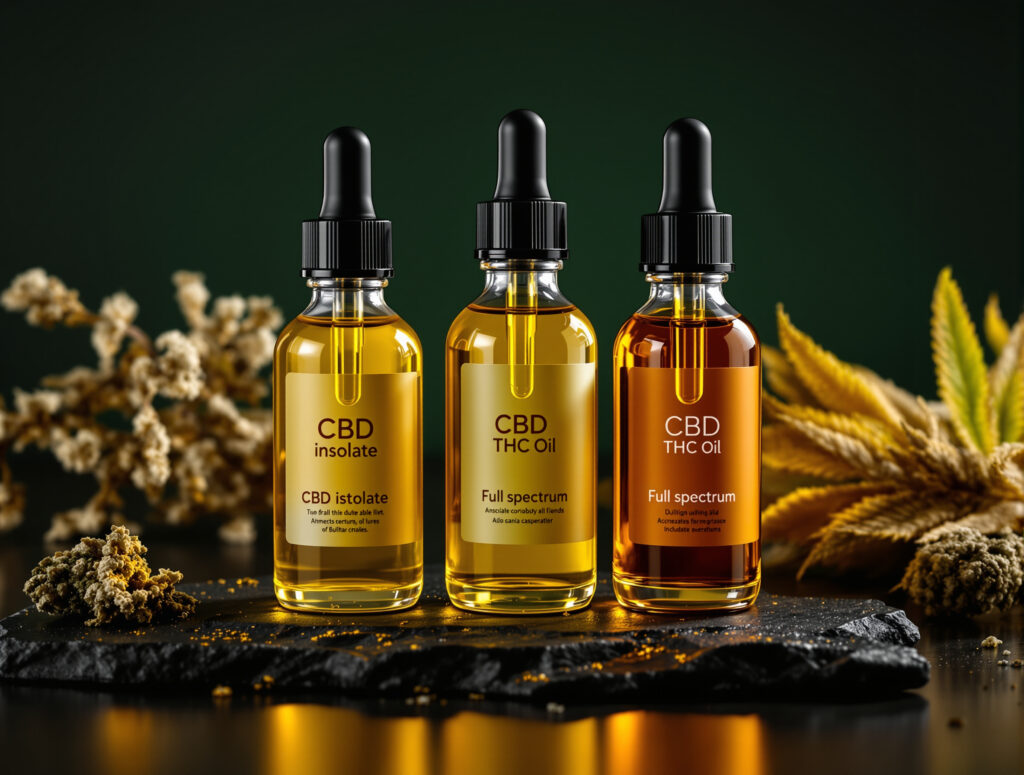
In German usage, the term cannabis oil encompasses several completely different product categories, which regularly leads to confusion when searching for an effective sleep aid. However, the legal and pharmacological distinction is clear. CBD oil is freely available in Germany as long as THC content is below 0.3 percent and is marketed as a dietary supplement or cosmetic. It contains cannabidiol as the main active ingredient, usually along with a carrier oil such as MCT, hemp oil, or olive oil. Medical cannabis oil, often prescribed as a full extract under brand names like Sativex, Tilray, or Bedrolite, is a prescription drug containing the full spectrum of active ingredients from the cannabis flower in standardized concentration. THC contents here range from a few milligrams per milliliter to highly potent 25-percent extracts.
Pure CBD oil from the free market can be a sensible option for mild, situational sleep onset difficulties. A 2019 observational study published in the Permanente Journal showed that 66.7 percent of users with sleep problems reported subjectively improved sleep quality already in the first month. The effect size is, however, modest, and the study landscape on isolated CBD effects on sleep remains weak. Those suffering from chronic, clinically relevant insomnia benefit more clearly from a THC-containing full-spectrum oil according to current evidence, because THC demonstrably shortens sleep onset latency and extends deep sleep phases. The psychotropic component is manageable with low evening dosing and is further dampened by the CBD content. This synergy is precisely why full-spectrum oils are preferred over THC isolates and CBD isolates in specialized sleep clinics.
The contained terpenes also play a decisive role. Myrcene, found in many indica-dominant strains, is considered sedating and acts synergistically with THC. Linalool, the active ingredient also responsible for the calming effect in lavender, enhances the anxiolytic component. Caryophyllene in turn binds itself to CB2 receptors and can dampen the stress axis. Those specifically seeking cannabis oil for sleep disorders should therefore not only pay attention to cannabinoid content but also to the declared terpene profile of the product. Standardized full extracts declare these values transparently. The generic statement „CBD oil helps with sleep“ thus does not do justice to the biochemical complexity, as not every oil is equally suitable for every sleep problem.
Dosing Cannabis Oil for Sleep Disorders: Start Low, Go Slow

The golden rule of cannabis medicine is „start low, go slow,“ and it applies especially to treating sleep disorders. With medical cannabis oil containing THC, experienced sleep physicians typically start with 2.5 to 5 mg THC combined with the same amount of CBD, administered about one hour before the desired sleep time. The oral bioavailability of cannabinoids is 6 to 20 percent, and onset of action is delayed when swallowed to 30 to 90 minutes. Those who drop the oil sublingually under the tongue and hold it there for a minute significantly accelerate the onset effect. Duration of action ranges from six to eight hours depending on metabolism, making drops pharmacokinetically better suited for staying asleep than short-acting vaporizer applications.
Weekly increases proceed in steps of approximately 2.5 mg THC until the individual effective dose is found. In most cases, this settles between 5 and 15 mg THC combined with 5 to 15 mg CBD. Higher doses exceeding 20 mg THC per night rarely provide additional benefit, instead bringing more side effects such as morning residual sleepiness, concentration problems, and a so-called hangover effect. Pure CBD oils, by contrast, are often dosed significantly higher with evening amounts between 25 and 75 mg because the anxiolytic effect of CBD has a substantially higher dose threshold than its psychotropic partner. A rough rule of thumb: those working with a 10-percent CBD oil start with three to five drops in the evening and slowly increase the dose over two weeks. Noticeable effects on sleep often occur only after seven to fourteen days of continuous use because the endocannabinoid system needs time to re-balance itself.
Tolerance development is an often underestimated topic. With chronic evening use, THC preparations lose potency for sleep onset latency after several months while REM suppression persists. Specialized sleep clinics therefore recommend taking a therapy break of seven to fourteen days every three months to resensitize CB1 receptors. For more on the mechanisms of such a break, our article on tolerance breaks provides scientific context. During this break, more intense dreams and a brief period of fragmented sleep can occur temporarily—an effect known as REM rebound that subsides after two to three weeks. Sleep hygiene remains fundamental alongside medical therapy: fixed sleep times, a cool bedroom at 16 to 19 degrees Celsius, no screen light in the last hour before bed, and avoiding caffeine from early afternoon onward.
Cannabis Oil for Mental Health Issues Beyond Sleep: Anxiety, Depression, PTSD
Sleep disorders rarely occur in isolation. In practice, they are often the most prominent symptom of an underlying anxiety disorder, moderate depression, or post-traumatic stress disorder. Those who ignore the mental health context ultimately treat only the symptom, not the cause. This is precisely why specialized cannabis clinics never view sleep as an isolated phenomenon but as an indicator of the entire emotional system’s balance. Cannabis oil works on multiple levels here: it lowers amygdala activity, dampens the hypothalamic-pituitary-adrenal axis, and reduces subjectively experienced tension—the actual lever for better sleep for many affected individuals.
In generalized anxiety disorder, smaller studies show moderate efficacy of CBD at doses starting from 300 mg daily, though evidence for lower doses typical of freely available oils is rather weak. With depression, the situation is even more differentiated. Cannabis oil is not an antidepressant in the classical pharmacological sense but can enable stabilization of daily structure in patients with pronounced sleep disorders and anhedonia as adjunctive therapy. The aforementioned 2026 Lancet meta-analysis, however, found insufficient overall evidence for the depression indication, significantly complicating medical prescriptions for this indication. The study landscape for PTSD looks somewhat more favorable: REM suppression by THC demonstrably reduces the frequency of trauma-related nightmares, and the synthetic cannabinoid nabilone is already approved in some countries for treating therapy-resistant PTSD-related sleep disorders.
Realistic expectations are important. Cannabis oil replaces neither psychotherapy nor indicated antidepressant or anxiolytic medication. However, it can play a meaningful role in a multimodal treatment concept, for example as a sleep-promoting add-on with selective serotonin reuptake inhibitors that additionally disturb sleep in many patients. Here too: prescription belongs in specialized hands, and close follow-up monitoring is mandatory. The 2026 Lancet review explicitly points to substantial risks in vulnerable groups, particularly adolescents, young adults, and people with bipolar disorder or a history of psychotic episodes. In these patient groups, cannabis therapy is contraindicated or requires particularly critical indication assessment.
Risks, Side Effects, and Drug Interactions with Antidepressants
Compared to benzodiazepines and Z-drugs, cannabis oil is considered pharmacologically safe but is by no means free of side effects. Common adverse effects include dry mouth, mild drowsiness the next day, dizziness upon standing, and a temporary drop in blood pressure. In studies, discontinuation rates due to side effects ranged between 5 and 15 percent, significantly lower than with classical hypnotics. At higher THC doses, additional effects can include concentration problems, subjectively experienced thinking slowdown, and in individual cases mood changes. Development of psychological dependence is documented with chronic use. If therapy is abruptly discontinued, temporary sleep disorders, inner restlessness, and intense dreams may occur for up to six weeks, requiring medically supervised tapering.
Particular attention is warranted to interactions with antidepressants since many people with sleep disorders are also treated with SSRIs, SNRIs, or mirtazapine. CBD inhibits several cytochrome P450 enzymes, particularly CYP3A4 and CYP2C19, which are responsible for metabolizing numerous antidepressants. Specifically affected are, among others, citalopram, sertraline, venlafaxine, and mirtazapine. The consequence: plasma levels of the concomitant medication rise, which can intensify both the actual effect and side effects. In practice, this is either utilized therapeutically or compensated through dose adjustments, but unsupervised combination is risky. Drug interactions with anticoagulants such as warfarin, certain antiepileptics, and immunosuppressants after organ transplant also belong in medical follow-up monitoring.
Another relevant point is driving ability. THC-containing cannabis oil can even with low evening dosing lead to measurable residual levels the next day. Those who drive due to work obligations should coordinate an individual plan with their treating physician that times administration so residual plasma concentration in the morning stays below the legally relevant threshold. Pure CBD oil without detectable THC content is unproblematic here, though users should know that so-called THC-free products regularly contain trace amounts and in rare cases can trigger positive drug screenings. The burden of proof lies ultimately with the consumer, requiring careful product selection with complete analysis certificate where professional or traffic law relevance exists.
Cannabis Oil on Prescription in Germany 2026: How Prescription Works
Since the Cannabis as Medicine Act came into force in 2017, medical cannabis oil can be prescribed by any licensed physician except veterinarians and dentists. Unlike the freely available variety from hemp shops, this involves a controlled substance prescription that is individually prepared in the pharmacy from standardized extracts. The indication of sleep disorders is not an independent primary indication but is typically prescribed in the context of a serious illness, such as chronic pain, neurological disorders, post-traumatic stress disorder, or palliative medicine situations where sleep disorder is treated as a concomitant symptom. Those uncertain about what the prescription path looks like in practice will find the individual steps explained in our guide to cannabis on prescription.
Cost coverage by statutory health insurance has since 2017 been tied to an approval application that had to be submitted to the Medical Service before therapy began. The 2024 Cannabis Consumption Act simplified this hurdle for many indications, though complete coverage is still not guaranteed. For pure sleep disorders without additional serious illness, insurance companies regularly reject applications. Self-paying patients must expect monthly costs of between 150 and 600 euros for medical cannabis oil, depending on active ingredient concentration and daily dose. Privately insured individuals typically receive faster and more straightforward reimbursement provided medical indication is physician-documented. A comprehensive overview of the entire supply pathway is provided by our patient guide to medical cannabis 2026.
Those who do not receive a prescription also have since partial legalization in 2024 the theoretical option of home cultivation for personal use or access through a cannabis cultivation association. These paths, however, are only limited suitable for controlled sleep therapy because neither active ingredient content nor purity are standardized. A reproducible dosage—crucial for chronic sleep disorder therapy—can only be achieved with pharmaceutically standardized extracts. Freely available CBD oil remains and remains a low-threshold option for mild complaints but does not replace physician-supervised cannabis therapy for manifest sleep disorders or mental distress.
Frequently Asked Questions
Which cannabis oil is best for sleep?
For clinically relevant sleep disorders, a medical full-spectrum oil with balanced THC-CBD ratio empirically achieves the most pronounced effects because THC shortens sleep onset latency and extends deep sleep phases while CBD dampens the psychotropic effect and provides additional anxiolytic action. Indica-dominant strains with myrcene- and linalool-rich terpene profiles are preferred in specialized sleep clinics. Those struggling with mild, situational sleep onset problems can also achieve good results with a high-quality, freely available CBD full-spectrum oil in a concentration between 10 and 20 percent.
How quickly does cannabis oil work for sleep disorders?
Dropped sublingually under the tongue, cannabis oil develops its effects after 15 to 30 minutes, swallowed only after 30 to 90 minutes. The full therapeutic effect on sleep architecture, however, does not set in overnight. Pure CBD oil often requires seven to fourteen days of continuous evening use until the endocannabinoid system measurably improves sleep regulation. THC-containing preparations work faster on sleep onset latency, though overall sleep quality improvement similarly shows over several weeks.
Does cannabis oil for sleep disorders cause dependence?
Physical dependence in the classical sense does not develop with cannabis oil, though psychological dependence is documented with chronic use. Those who abruptly discontinue the preparation after extended therapy often experience temporary sleep disorders, vivid dreams, and inner restlessness that can persist for up to six weeks. This phase is medically manageable but can be significantly mitigated through gradual dose reduction over several weeks. Pure CBD preparations are considered safe in this regard since CBD itself has no addiction potential.
Is cannabis oil for sleep disorders covered by insurance?
For isolated sleep disorder without additional serious illness, statutory health insurance companies regularly reject cost coverage applications. If insomnia is treated within the context of a recognized primary indication, such as chronic pain, neurological disorders, or post-traumatic stress disorder, reimbursement is possible. Self-paying patients must expect monthly costs of between 150 and 600 euros. Privately insured individuals receive in most cases straightforward reimbursement provided physician indication is documented.
Can I combine cannabis oil with other sleep medications or antidepressants?
Combination with benzodiazepines, Z-drugs, or sedating antidepressants is fundamentally possible but strictly requires medical supervision. CBD inhibits several cytochrome P450 enzymes responsible for metabolizing numerous concomitant medications, particularly CYP3A4 and CYP2C19. This can elevate plasma levels of citalopram, sertraline, venlafaxine, or mirtazapine, intensifying effects but also causing side effects. Unsupervised combination without therapeutic guidance carries the risk of unexpectedly strong effects and should be avoided.
Further Articles on This Topic
Hast du schon einmal Cannabisöl gegen Schlafprobleme ausprobiert?






Branchen-Update
News, Analysen und Reportagen — mehrmals im Monat direkt in dein Postfach.
Folge uns