Cannabis legalization worldwide reached a pace by 2026 that seemed utopian a decade ago. Nearly fifty countries have decriminalized the substance in some form. Regulated markets now serve approximately 230 million people, and with Czechia, Germany, and Switzerland, three Central European countries are simultaneously moving toward legal models.
📑 Inhaltsverzeichnis
- Where is Cannabis Legal Worldwide? An Overview of 2026
- North America: From Pioneer Canada to U.S. States
- Europe: Between Pillar 2, Pilot Projects, and Coffeeshops
- Latin America and the Caribbean: Uruguay as Pioneer, Mexico in Limbo
- Africa, Asia, and Oceania: Between Legalization and Backlash
- Markets, Corporations, and the UN Framework
- What Comes After 2026? Trends and Forecasts
- Frequently Asked Questions
- 💬 Fragen? Frag den Hanf-Buddy!
To keep track of developments, you need more than the question „legal or illegal.“ It’s about home cultivation, social clubs, commercial pilot projects, medical prescriptions, and the thorny question of how national reforms align with international drug conventions. This guide categorizes the global landscape, compares the models of major regions, and shows which developments are expected through the end of 2026.
Where is Cannabis Legal Worldwide? An Overview of 2026
Global cannabis policy in 2026 falls into four broad categories. First, there is strict prohibition, which continues in much of Asia, the Middle East, and sub-Saharan Africa, with draconian penalties in some cases. Second, decriminalization, where consumption and possession of small amounts remain illegal but are not prosecuted in practice or are treated as administrative violations. Portugal, the Netherlands, Belgium, Spain, and numerous Latin American countries exemplify this model. Third, partially legalized countries that allow home cultivation, personal use, or non-commercial access through clubs without creating an open commercial market. Since 2024, this includes Germany and Malta, and since 2026, Czechia, as well as Luxembourg, South Africa, and Georgia with restrictions. Fourth, commercially fully regulated markets. So far, only Canada and Uruguay, plus 24 U.S. states, the District of Columbia, and Australia’s capital territory operate at this highest level.


Alongside this exists a broader medical track. Australia, Argentina, Brazil, Israel, the United Kingdom, most EU states, and a growing number of Asian and African countries allow doctors to prescribe cannabis as medicine. MJBizDaily’s industry analysis counted around fifty countries with formal medical cannabis regulations at the beginning of 2026. In Germany, patients have known this access route since 2017, thoroughly described in the 2026 patient guide. Internationally, however, the picture is heterogeneous, as some states restrict prescriptions to only a few indications or to finished pharmaceuticals without flower authorization.
What remains striking is the gap between formal law and actual practice. In Spain, Cannabis Social Clubs operate in thousands within a legal gray zone without national regulation. In the U.S., money flows into an industry whose products remain federally illegal. And in Thailand, the political climate shifted in 2024 from pro-legalization to renewed restriction. This patchwork character is no longer a transitional phenomenon but defines international cannabis policy in the second half of the 2020s.
North America: From Pioneer Canada to U.S. States
Canada was the first G7 country to commercially legalize cannabis in 2018. Eight years later, the market has consolidated, an early wave of excess and stock market failures is behind the industry, and provinces experiment with different distribution models, from state monopolies in Quebec to private licensed retailers in Ontario. For Germany, Canada’s role as an exporter is noteworthy. According to data from the Federal Institute for Drugs and Medical Devices, 62 percent of all medical cannabis flowers imported to Germany now come from Canada, well ahead of Portugal, North Macedonia, and Australia. Thus, legalization is no longer merely a societal issue but a concrete foreign trade matter.
The United States, meanwhile, has long provided a prime example of legal incoherence. Twenty-four states and the District of Columbia have legalized cannabis for adults, forty states allow medical use, and industry revenue exceeded thirty billion U.S. dollars in 2025. At the federal level, however, cannabis long remained Schedule I, pharmacologically equated with heroin. In April 2026, the Justice Department took a partial step that electrified the industry.
Under DEA instruction, FDA-approved cannabis medicines and products from state-licensed medical programs were classified as Schedule III, bringing tax and research-related relief. The originally planned shift of all cannabis to Schedule III will be debated in a hearing series starting in late June 2026. Recreational cannabis remains federally illegal for now, continuing to burden banking, trademark protection, and tax practice.
Mexico, finally, has been in a peculiar limbo for years. The Supreme Court declared the cannabis ban unconstitutional in 2021, yet comprehensive parliamentary regulation is still missing. Consumption and home cultivation for adults are factually permitted, but no legal market exists. The contrast between the legal finding and political reality shows how difficult reforms are to implement in an environment shaped by drug war logic.
Europe: Between Pillar 2, Pilot Projects, and Coffeeshops
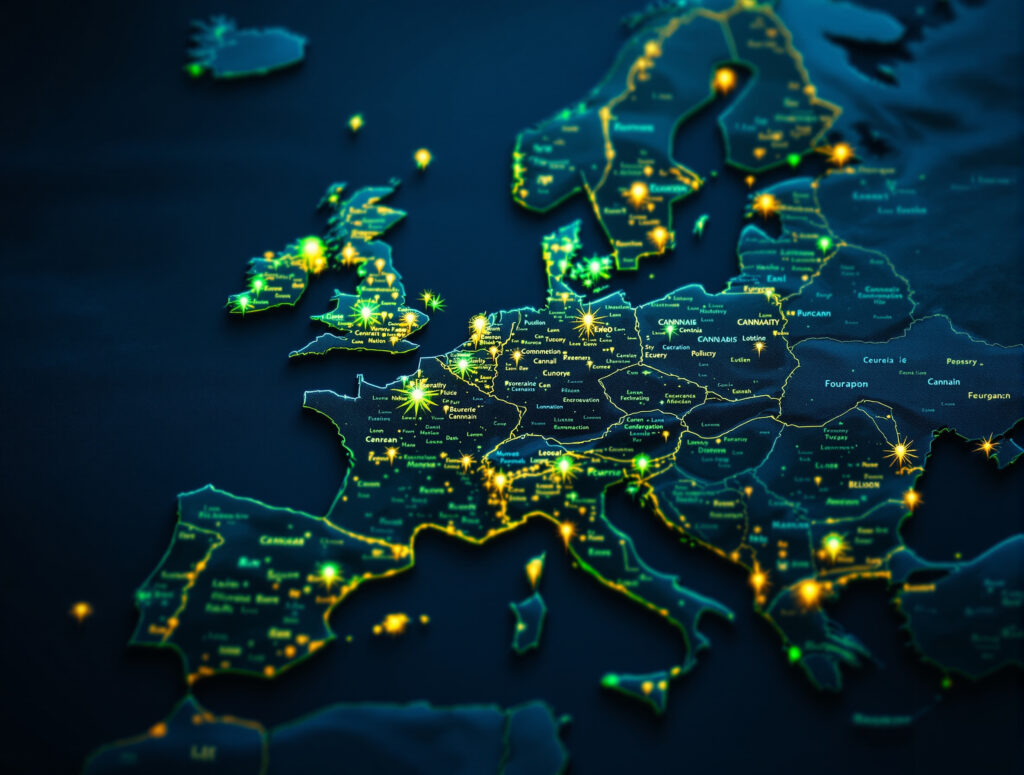
Europe in 2026 is the world’s most exciting cannabis policy laboratory. With Germany, Malta, Luxembourg, and Czechia since January, four EU member states exist where adults can legally possess, grow, and obtain cannabis through association-based structures. Add to this Switzerland and individual Dutch cities with commercial pilot projects, Spain’s quasi-legal social clubs, and Portugal’s decriminalization established since 2001. This density of models provides comparable data unlike anywhere else in the world.
Under Germany’s Cannabis Act (CanG), since April 1, 2024, home cultivation of up to three plants and purchase through cultivation associations are permitted. A review of the first two years shows mixed results, as documented in the article on the Cannabis Act’s balance sheet. Police statistics and addiction research report relief or concerns depending on the indicator; the black market hasn’t disappeared but has visibly shrunk regionally. The economically crucial step, commercial Pillar 2 with regional pilot projects, has been stuck in interagency coordination for two years. The Federal Agency for Agriculture and Food has received 60 applications, of which 34 are genuine pilot schemes, but no sales launch is scheduled for 2026 in any region.
Czechia implemented its own reform on January 1, 2026. Adults aged 21 and over may grow up to three plants and possess 100 grams at home and 25 grams in public. A commercial market is explicitly not part of this first reform but is planned for a second stage once EU legal hurdles are clarified. Switzerland pursues a different path. With pilot projects in Zurich, Basel, Bern, and Lausanne, the confederation has tested regulated sales to registered consumers since 2023. The Zurich project Züri Can has been extended until 2028, with more municipalities joining. In February 2025, the Federal Council also submitted a draft law for consultation that would establish a state-controlled cannabis market. If it passes Parliament and the people, Switzerland would become the fourth European country with explicit adult regulation, after Malta, Luxembourg, and Germany.
The Netherlands, for decades synonymous with tolerated cannabis use, undergoes a dual transformation. On one hand, the coffeeshop pilot project with around 80 businesses sells exclusively legally produced cannabis, finally closing the decades-old backdoor problem. On the other hand, Amsterdam has closed coffeeshops in the city center for tourists, marking a course change that is more about city marketing than drug policy. Spain’s social clubs flourish following the Catalan model without nationwide regulation. Portugal maintains its pragmatic decriminalization and reports among the lowest drug death rates in Western Europe. The United Kingdom remains restrictive but has created a formally legal access route to medical cannabis through specialty clinics, now used by an estimated 50,000 patients.
Latin America and the Caribbean: Uruguay as Pioneer, Mexico in Limbo

Uruguay legalized cannabis in 2013, well before Canada. The model is state-centered. Registered users obtain cannabis through pharmacies, cannabis social clubs, or home cultivation. Economically, the market remained modest but stable and today serves as evidence that even a relatively small state can operate consistent regulation without social upheaval. Argentina, Chile, Colombia, and Peru have implemented medical cannabis programs, some with restrictive import rules, others with access to a legal export market. Colombia has become the third-largest supplier of medical cannabis flowers to Europe, a role that gradually emancipates the country from its historical entanglement with the illegal drug market.
Brazil has allowed medical cannabis since 2015, but commercial home cultivation remains prohibited, and patient organizations report bureaucratic hurdles. Costa Rica legalized industrial hemp cultivation in 2022 and is working on a medical program. In the Caribbean, Jamaica is the most prominent actor, where cannabis is considered part of Rastafari religious practice, small amounts are decriminalized, and the island nation exports medical cannabis to Europe. Saint Vincent and the Grenadines and Barbados pursue similar paths, treating cannabis as both an economic factor and cultural heritage. Mexico remains the outlier, with reform potential long invoked but never delivered.
Africa, Asia, and Oceania: Between Legalization and Backlash
South Africa took an unexpected step for the continent in 2018. The Constitutional Court ruled the prohibition of consumption and home cultivation incompatible with privacy rights. Since then, home cultivation is permitted, but no commercial market exists. Lesotho, Malawi, Zambia, Zimbabwe, Morocco, and Rwanda have issued licenses for medical-industrial cultivation and position themselves as exporters to the European market, where demand grows much faster than supply in 2026. Morocco, historically Europe’s most important hashish supplier, established the first legal cultivation in the Rif Mountains in 2021 and exported the first certified harvests in 2024.
Asia shows two seemingly opposite movements. On one hand, medical cannabis programs expand in Israel, Sri Lanka, South Korea, Japan, the Philippines, and Hong Kong, albeit under strict regulations. On the other hand, Thailand reversed its reform course begun in 2022. The new conservative government announced in 2024 plans not to reclassify cannabis as a controlled substance but to strictly control the nearly unregulated market. Several thousand coffeeshops that emerged throughout the country after 2022 must obtain licenses or close. Thailand’s case has become a cautionary tale of how quickly reforms without robust regulatory infrastructure can unravel.
Australia has decriminalized cannabis in its capital region (ACT) for adults; the rest of the country focuses on a growing medical program with over 500,000 patients. New Zealand failed a narrow referendum in 2020 but maintains its medical program. In Japan, long a country with particularly harsh drug policy, medical use of cannabinoid-based pharmaceuticals has been permitted since 2024. The step shows that even the strictest Asian drug regimes gradually become permeable through pharmaceutical interests and patient pressure.
Markets, Corporations, and the UN Framework
The global legal cannabis market was valued at around 65 billion U.S. dollars in annual revenue in 2025, with growth projections ranging between eight and fourteen percent annually depending on the analyst. The largest single market is the U.S., followed by Canada and Germany, with the German medical market becoming Europe’s fastest-growing segment with over 800,000 active patients in 2026. The industry landscape has shifted. The stock bubble of 2018-2020 has burst; instead of major corporations, specialized mid-sized companies dominate, often relying on supply chains between Latin America, Iberia, and Central Europe. Cannabis corporations like Tilray, Aphria, Aurora, or Curaleaf have undergone painful consolidations; Canadian producers now earn more from exporting medical flowers to Europe than from the domestic recreational market.
Politically, all national reforms hang on the international drug framework. The Single Convention on Narcotic Drugs of 1961, supplemented by the 1971 and 1988 conventions, continues to form the corset within which cannabis policy moves. The UN Commission on Narcotic Drugs removed cannabis from Schedule IV of the 1961 Convention in 2020, strengthening medical use without abandoning the general prohibition. This is more than symbolic, as the removal allows treaty states easier research and a medical prescription regime. A complete renegotiation of the conventions is not on the 2026 agenda but is quietly under way in diplomatic discussions, especially between Canada, Germany, Malta, Switzerland, and a number of South American states. The politically touchiest aspect of many national reforms is precisely this conflict with international law, which rarely becomes justiciable but must be cleanly addressed legally.
Within the EU, the common legal framework is also under scrutiny. Framework Decision 2004/757/JI obligates member states to minimum penalties for illegal drug trafficking but leaves room for designing consumption and home cultivation rules. The EU Commission reviewed each case—Czechia’s, Malta’s, and Germany’s—to determine whether the national reform touches the framework decision and found no violation in any case, as long as the non-commercial character is maintained. The Pillar 2 is precisely where this becomes the litmus test, as state-licensed commercial sales are barely compatible with the framework decision in its current interpretation. Brussels is working on an update to its drug strategy for 2026-2030, in which this question appears discreetly but inevitably.
What Comes After 2026? Trends and Forecasts
Three developments will shape the coming years. First, whether Germany actually launches Pillar 2 in at least some model regions. Should sales in specialty shops become reality in 2026 or 2027 in two or three cities, it would significantly increase European reform pressure, because for the first time a G7 member state would be opening a commercial adult market. Second, the fate of the U.S. federal rescheduling procedure. A shift to Schedule III would dramatically change industry economics in the United States, especially through elimination of tax rule 280E, which currently forces cannabis businesses into effective tax rates of seventy percent and higher. Third, the reform of the UN convention system, which while not landing before a chamber in the coming years, gains urgency through the sheer number of reformed member states.
There is also a cultural shift. Cannabis is no longer the subject of a lifestyle revolution but is treated as an ordinary consumer good in many countries. Advertising bans, youth protection, and market supervision increasingly follow models for tobacco and alcohol. From an addiction research perspective, this is an opportunity because consumption patterns become better documented and controllable; from an industry perspective, it’s a challenge because marketing, branding, and product innovation must occur under strict conditions. To understand cannabis policy in 2026, you must move beyond the binary question „legal or illegal.“ The truly relevant questions today are which distribution pathway, which tax burden, which patient access, and which research framework applies locally. In this differentiation lies the true maturity of a cannabis reform.
Frequently Asked Questions
In which countries is cannabis fully commercially legal in 2026?
Fully commercially legalized with a nationwide market in 2026 are only Canada and Uruguay. Within the U.S., 24 states plus the District of Columbia have a recreational market; in Australia, it’s the capital territory (ACT). Germany, Malta, Luxembourg, and Czechia allow home cultivation and non-commercial access but lack an open commercial market so far.
Is cannabis legal in Germany?
Since April 1, 2024, cannabis is partially legalized in Germany for adults. Home cultivation of up to three plants, possession of 25 grams in public and 50 grams at home, and purchase through cultivation associations are permitted. Commercial sales in specialty shops are planned via Pillar 2 but have not started by 2026. A thorough assessment is provided in the article on the Cannabis Act’s balance sheet.
What changes in 2026 in Czechia?
A reform took effect on January 1, 2026, in Czechia, allowing adults aged 21 and over to grow up to three plants and possess 100 grams at home and 25 grams in public. A commercial market is not part of this first stage but is planned for a second reform once EU legal questions are clarified.
How far along is cannabis legalization in the U.S.?
In 2026, 24 states allow cannabis for adults, and 40 states have medical programs. At the federal level, cannabis remained Schedule I, with the DEA continuing to classify recreational cannabis as illegal. In April 2026, however, the Justice Department classified FDA-approved cannabis medicines and state-licensed medical products as Schedule III. A comprehensive hearing starting in late June 2026 will decide on shifting all cannabis.
How large is the global cannabis market in 2026?
The legal cannabis market is estimated at around 65 billion U.S. dollars in annual revenue in 2025, with growth rates between eight and fourteen percent. The largest market is the U.S., followed by Canada and Germany. The German medical market counted over 800,000 active patients in 2026 and is Europe’s strongest growth segment.
Where is medical cannabis permitted?
Around fifty countries had formal medical cannabis regimes in 2026, including Canada, all 28 EU member states with few exceptions, the United Kingdom, Switzerland, Australia, Israel, Argentina, Brazil, Colombia, Mexico, Thailand, Sri Lanka, Japan, and South Korea. The range spans from comprehensive programs with flower authorization to strict regulations allowing only finished pharmaceuticals.
More Articles on This Topic
- Cannabis Regulation in Switzerland: SGK-N Refers Proposal Back to Subcommittee
- Lausanne Pilot Project: Lower Consumption and Million-Dollar Losses for the Black Market
Wie gut kennst du die Cannabis-Gesetze in anderen Ländern?




Branchen-Update
News, Analysen und Reportagen — mehrmals im Monat direkt in dein Postfach.
Folge uns