Note: This article was created in editorial collaboration with our advertising partner Ganja Farmer Seeds. Mentioned varieties should be understood as market observation. Variety information and THC values come from manufacturer and variety descriptions and are not intended as consumption recommendations.
📑 Inhaltsverzeichnis
- What Does a High THC Content Mean in Cannabis?
- The Strongest Cannabis Strains at a Glance
- Why Laboratory Values Aren’t Always Real-World Values
- THC Isn’t Everything: The Role of the Entourage Effect
- Cannabinoids and Terpenes: Why the Effect Profile Is Decisive
- Risks of Very High-Potency Cannabis Strains
- Comparison Table of the Strongest Cannabis Strains
- Conclusion: Putting THC Peak Values in Perspective
- Frequently Asked Questions About the Strongest Cannabis Strains
- 💬 Fragen? Frag den Hanf-Buddy!
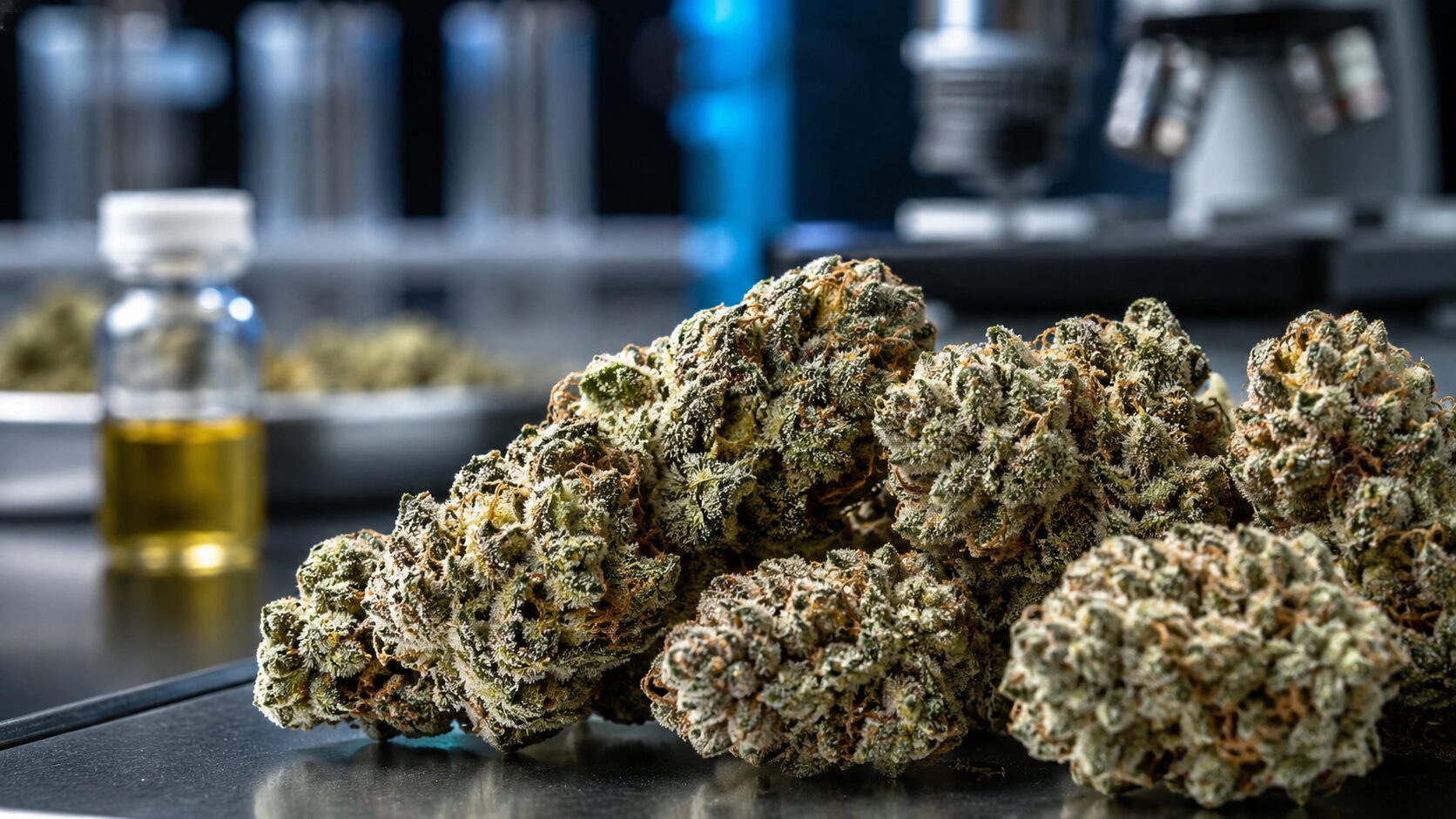
High-potency cannabis strains have become their own segment within modern cannabis genetics. These are varieties that achieve exceptionally high THC peak values in variety descriptions, manufacturer information, or individual laboratory analyses. Such figures usually represent maximum values under ideal conditions and do not automatically indicate the average active compound content of every real-world batch available.
THC, more precisely Delta-9-tetrahydrocannabinol, is the central psychoactive compound in cannabis plants. However, terpene profiles, other cannabinoids, dosage, tolerance, consumption method, and legal context also matter for the effects. Laboratory programs like NIDA potency data track THC and CBD as central measurements, but they also show that analysis values always relate to specific samples.


What Does a High THC Content Mean in Cannabis?
A high THC content means that a large portion of the plant material consists of psychoactively effective THC. Values starting at 35 percent already fall into the range of extreme peak values.
It’s important to distinguish between genetic potential, laboratory value, and real-world value. A variety can reach „up to 41 percent THC“ according to the breeder without every flower of that variety actually containing 41 percent. Phenotype, environment, maturity level, drying, storage, and measurement method all influence the result. For this reason, extreme THC peak values should never be understood as a blanket quality guarantee.
The Strongest Cannabis Strains at a Glance
The following varieties are frequently mentioned when discussing the strongest cannabis strains and maximum THC percentages. The information is deliberately formulated as peak values. They serve for classification, not as consumption recommendations.
Think Tank: Up to 41 Percent THC
In current variety information, Think Tank is described as a 50/50 hybrid from Tea Time and High Mars and is listed with a THC content of up to 41 percent. This makes it one of the most striking high-THC strains in many rankings. Such a value is extraordinarily high and should be read as a laboratory or catalog peak, not as a guaranteed average value.
From a professional perspective, Think Tank demonstrates how strongly modern breeding is focused on potency, resin production, and distinctive effect profiles. What remains decisive is whether a specific batch has an analysis certificate and what the complete cannabinoid and terpene profile looks like.
Chimera Cut: Up to 38.5 Percent THC
Chimera Cut is listed with up to 38.5 percent THC and likewise falls in the extremely high-potency range. The strain is often described with an intense aroma profile that is said to combine creamy, sweet, and wine-like notes. For ranking purposes, the THC value is relevant, but practically it’s only part of the picture.
38.5 percent THC can describe an exceptional sample but doesn’t necessarily reflect typical market reality. When comparing such strains, you should check whether the value comes from transparent analysis or was taken from general variety descriptions.
Future #1: Up to 37 Percent THC
Future #1 is one of the most well-known names in the realm of extremely potent cannabis strains. The variety is listed with up to 37 percent THC and is thus a good example of the new high-THC generation.
The significance of Future #1 lies not only in its high THC value. When strains are reduced to record values, other quality factors easily slip out of view: stability, aroma, tolerability, cannabinoid balance, and reliable batch analyses.
High Mars: Up to 36 Percent THC
High Mars is mentioned with up to 36 percent THC and remains clearly in the range of very potent strains. It’s also interesting because it’s named as a genetic component of Think Tank.
Again, 36 percent THC should be understood as a maximum specification. A real batch can fall below this and still be very strong. In practice, the difference between 30, 36, and 41 percent is less straightforward than a table might suggest.
Why Laboratory Values Aren’t Always Real-World Values
Laboratory values are important because they provide comparative data. At the same time, they are generated under specific conditions. A particularly resin-rich sample, an exceptional phenotype, or optimal cultivation can achieve higher values than the average of the same strain.
For this reason, extreme values over 35 percent THC are usually outliers or best values under ideal laboratory and growing conditions. In commerce, pharmacies, or legal distribution structures, real batches typically show lower values. More informative than a single record value are laboratory certificates, complete cannabinoid profiles, and clear origin information.
The legal framework also belongs to the overall context. In Germany, the Cannabis Act regulates, among other things, private home cultivation by adults for personal use, collective non-commercial home cultivation in cultivation associations, and the supply of cannabis for medical purposes. Strain information should therefore always be read within the framework of applicable laws.
THC Isn’t Everything: The Role of the Entourage Effect
THC content is easy to compare, but it doesn’t fully explain a strain’s effects. The entourage effect is about the interaction between THC, other cannabinoids, terpenes, and other plant compounds. Two strains with similar THC values can differ significantly: one acts more clear and stimulating, while the other is heavy, physical, and sedating.
Terpenes like myrcene, limonene, caryophyllene, linalool, or pinene shape aroma and flavor. Cannabinoids like CBD, CBG, or CBC can further alter the overall profile. For this reason, a high THC value should always be considered together with the terpene profile and the ratio of cannabinoids.
Cannabinoids and Terpenes: Why the Effect Profile Is Decisive
For a serious strain comparison, the question „How much THC?“ is not enough. More important is: Which cannabinoids are present? Which terpenes dominate? Is the strain described as more euphoric, focusing, or relaxing?
A strain with 28 percent THC and a balanced profile can be better tolerated by some users than a strain with over 35 percent. For research, specialized strain guides like House of Seeds or MySeeds are helpful. GanjaFarmer.de can also be used subtly as an orientation point when you want to compare strain profiles, genetics, aroma, and potency information without making THC the sole quality measure.
Risks of Very High-Potency Cannabis Strains
Very high THC values can trigger strong psychoactive effects: intense euphoria, altered perception, concentration problems, heavy sedation, restlessness, heart palpitations, or anxiety. Inexperienced consumers in particular can be overwhelmed by extremely potent strains. Caution is also necessary for those with pre-existing mental health conditions, anxiety tendencies, or those taking medications. The CDC and NIDA generally point out that cannabis can affect the body, brain, mood, thinking, and perception.
A neutral safety note therefore belongs to every serious discussion: High-potency cannabis strains are not automatically „better.“ More THC can mean stronger effects but also increases the likelihood of unwanted reactions. Those using cannabis medically should follow medical guidelines. Those seeking general information should not interpret strain information as an encouragement to consume.
Comparison Table of the Strongest Cannabis Strains
| Strain | Maximum THC Value According to Strain Information | Classification |
|---|---|---|
| Think Tank | Up to 41 Percent | Extremely high-potency, peak value |
| Chimera Cut | Up to 38.5 Percent | Very high THC content |
| Future #1 | Up to 37 Percent | High-potency strain |
| High Mars | Up to 36 Percent | Very potent strain |
The table shows how closely the mentioned strains cluster in the upper range. Nevertheless, a ranking is only truly reliable if the measured values were obtained under comparable conditions. Without identical standards, the table remains an orientation, not a definitive ranking.
Conclusion: Putting THC Peak Values in Perspective
Think Tank with up to 41 percent, Chimera Cut with up to 38.5 percent, Future #1 with up to 37 percent, and High Mars with up to 36 percent mark the peak of current high-THC strains. They demonstrate how far modern cannabis breeding has gone in terms of potency and resin production.
A good strain is not defined solely by its highest THC value. What matters is stability, transparency, terpene profile, cannabinoid balance, and tolerability. Extreme values over 35 percent THC should be understood as laboratory or catalog peaks. Real batches may be lower but still very strong.
Those comparing the strongest cannabis strains should remain critical, use multiple sources, and not equate THC with quality. House of Seeds, MySeeds, and GanjaFarmer.de can serve as starting points for strain research but do not replace laboratory analysis or medical or legal consultation. THC peak values are fascinating, but effects, risk, and quality emerge from the overall profile of the plant.
Frequently Asked Questions About the Strongest Cannabis Strains
What Is the Strongest Cannabis Strain in 2026?
Currently, Think Tank with laboratory values of up to 41 percent THC is considered the strongest documented cannabis strain, followed by Chimera Cut (38.5%) and Future #1 (37%). However, such peak values come from selected laboratory samples and are rarely achieved in normal cultivation.
Are High-Potency Cannabis Strains More Dangerous?
A higher THC content increases the risk of side effects such as anxiety, heart racing, and psychological distress, especially in inexperienced users. Even isolated high-potency compounds like THCJD, the most potent naturally occurring cannabinoid, show how quickly active compound strength can exceed a healthy level.
Why Do Strains Achieve Higher THC Values in the Laboratory Than at Home?
Laboratory values are based on optimally grown, carefully dried, and selected flower samples. Growing errors, insufficient light, improper storage, and natural THC degradation significantly lower real-world potency. The fact that THC content has increased globally doesn’t change this wide fluctuation range.
Is High THC Content the Same as Good Quality?
No. For effects and quality, the interplay of cannabinoids and terpenes is decisive, the so-called entourage effect. Learn more in the complete guide to cannabis terpenes and in our overview of the medical applications of tetrahydrocannabinol.
Are There New High-Potency Cannabinoids Beyond THC?
Wie wichtig ist dir der THC-Gehalt bei der Sortenwahl?
Yes. Beyond classic THC, new and sometimes stronger cannabinoids are constantly being researched. An example is THCPO, a new high-potency cannabinoid, whose effect profile has been little studied and which intensifies the debate about potency even further.






Branchen-Update
News, Analysen und Reportagen — mehrmals im Monat direkt in dein Postfach.
Folge uns