• Kolumnen
    • Interviews
  • 🎉 MJ Berlin 2026
  • Hanf Allgemein
    • Gesellschaft & Soziales
  • Drogenkunde
    • Safer Use
    • Pflanzliche Drogen
  • Produkte
  • Strain Reviews
  • Print Magazin
  • Tools
Sonntag, Juni 14, 2026
Hanf Magazin
  • News
  • Medizin
    • Cannabinoide
    • Erkrankungen
    • Cannabis bei Tieren
    • Erfahrungsberichte
  • Recht & Politik
    • Deutschland
    • Österreich
    • Schweiz
    • International
    • Rechtslage DE
    • Rechtslage International
  • Wissenschaft
    • Studien
    • Forschung
  • Growing
    • Indoor-Growing
    • Outdoor-Growing
    • Strains & Reviews
    • Equipment
  • Nutzhanf
    • Baustoffe
    • Rohstoffe
    • Lebensmittel
    • Kleidung
    • Kosmetika
  • Wirtschaft
  • Konsum & Lifestyle
    • Rauchen
    • Vaporisieren
    • Essen & Rezepte
    • Kultur & Szene
    • Termine & Events
No Result
View All Result
  • News
  • Medizin
    • Cannabinoide
    • Erkrankungen
    • Cannabis bei Tieren
    • Erfahrungsberichte
  • Recht & Politik
    • Deutschland
    • Österreich
    • Schweiz
    • International
    • Rechtslage DE
    • Rechtslage International
  • Wissenschaft
    • Studien
    • Forschung
  • Growing
    • Indoor-Growing
    • Outdoor-Growing
    • Strains & Reviews
    • Equipment
  • Nutzhanf
    • Baustoffe
    • Rohstoffe
    • Lebensmittel
    • Kleidung
    • Kosmetika
  • Wirtschaft
  • Konsum & Lifestyle
    • Rauchen
    • Vaporisieren
    • Essen & Rezepte
    • Kultur & Szene
    • Termine & Events
No Result
View All Result
Hanf Magazin
No Result
View All Result
Home Marihuana Growing Indoor-Growing für Anfänger & Profis

Living Soil vs. Hydroponics: Which Growing Method Delivers Better Results?

von Jonas Reuter
28.05.2026
in Indoor-Growing für Anfänger & Profis
Lesezeit: 8 Minuten
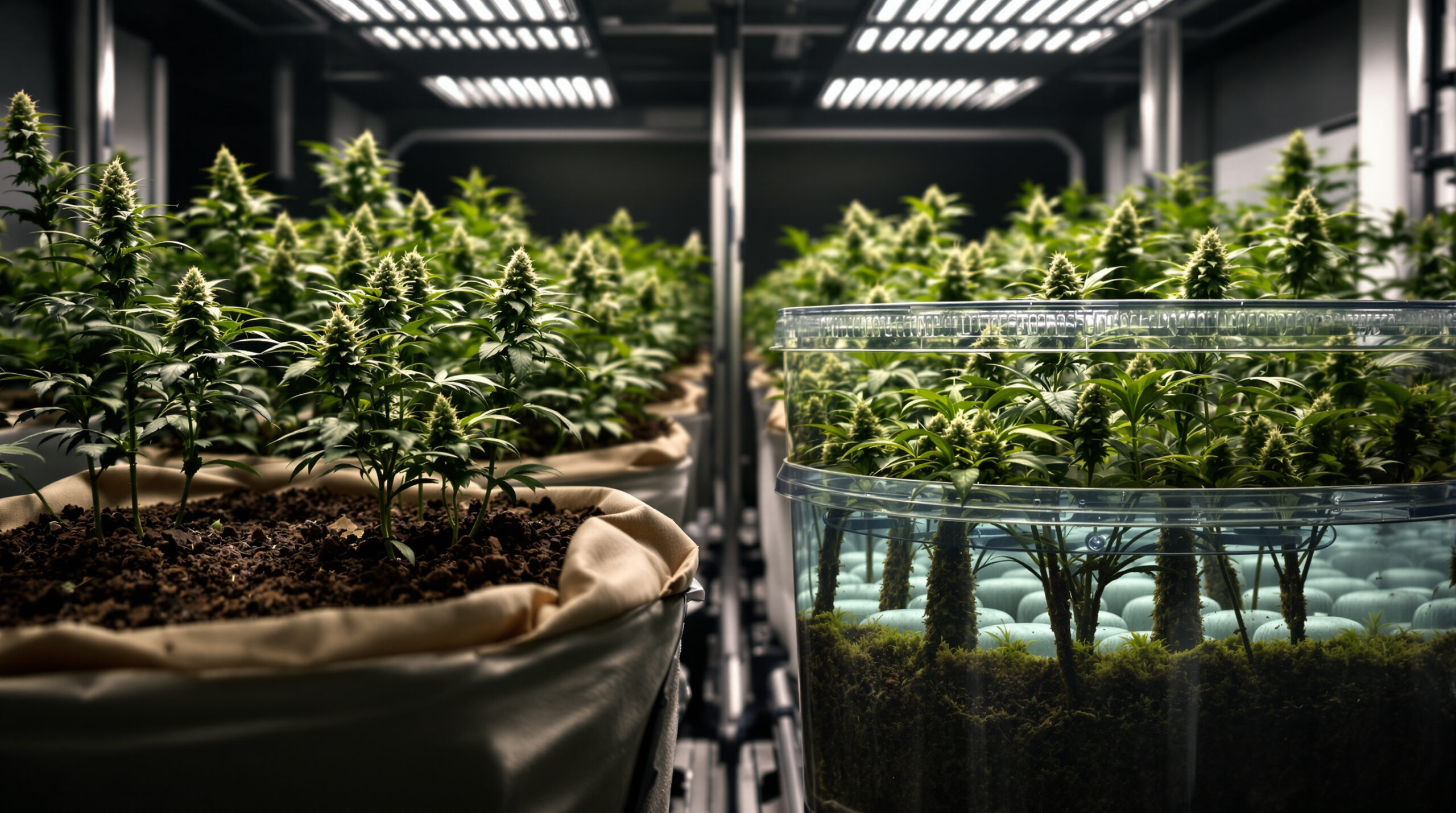
Zwei Cannabis-Anbaumethoden nebeneinander: Living Soil und Hydroponik
⏱ 10 Min. Lesezeit·1.954 Wörter
Teilen:WhatsAppFacebookXLinkedInE-Mail
🌐 This article was automatically translated from German. Browse all English articles

Living Soil or hydroponics—few questions divide the homegrow scene as reliably. Some swear by living soil, which works without mineral fertilizers and pH meters, while others favor crystal-clear nutrient solutions, precise control, and uncompromising growth rates. Both camps argue with yields, quality, and aroma; both have strong arguments. Anyone starting their own cultivation in 2026 or considering switching methods faces a serious decision that goes far beyond personal taste.

📑 Inhaltsverzeichnis

  1. Two philosophies, one plant: What fundamentally distinguishes living soil and hydroponics
  2. Living soil: How a living soil supplies the cannabis plant
  3. Hydroponics: Precision, speed, and the question of control
  4. Yield, flavor, and cannabinoid profile in direct comparison
  5. Effort, costs, and sustainability: What really differs
  6. Concrete recommendations for 2026: Hardware, substrates, and typical pitfalls
  7. Which method suits which grower?
  8. Frequently asked questions
  9. 💬 Fragen? Frag den Hanf-Buddy!

This comparison breaks down both cultivation methods without bias. We examine how living soil and hydroponics work, what technically distinguishes them, and where their real strengths and weaknesses lie. By the end, it should be clear which method suits which grower and what compromises each approach demands.

Two philosophies, one plant: What fundamentally distinguishes living soil and hydroponics

At their core, both terms describe radically different ways a cannabis plant obtains its nutrients. Living soil relies on a living soil where bacteria, fungi, protozoa, and soil organisms break down organic matter and make it available to the plant in precisely the right form. The grower doesn’t fertilize—they feed the soil life. The plant then takes up exactly what it needs.


GanjaFarmerGanjaFarmer

Hydroponics inverts this principle. The plant grows in an inert substrate or without a fixed medium at all. Water, oxygen, and precisely dosed nutrient salts are delivered directly to the root. The grower assumes the role that living soil performs naturally, controlling pH and electrical conductivity of the nutrient solution while managing every single component.

This creates a remarkable asymmetry. Living soil demands considerable knowledge of soil biology upfront but then runs stably and forgivingly. Hydroponics is simpler to understand in setup but tolerates hardly any errors in operation. Those familiar with the comparison between LED and HPS will recognize the pattern, as here too the decision isn’t about which method is universally superior, but rather which system fits your own practice.

Living soil: How a living soil supplies the cannabis plant
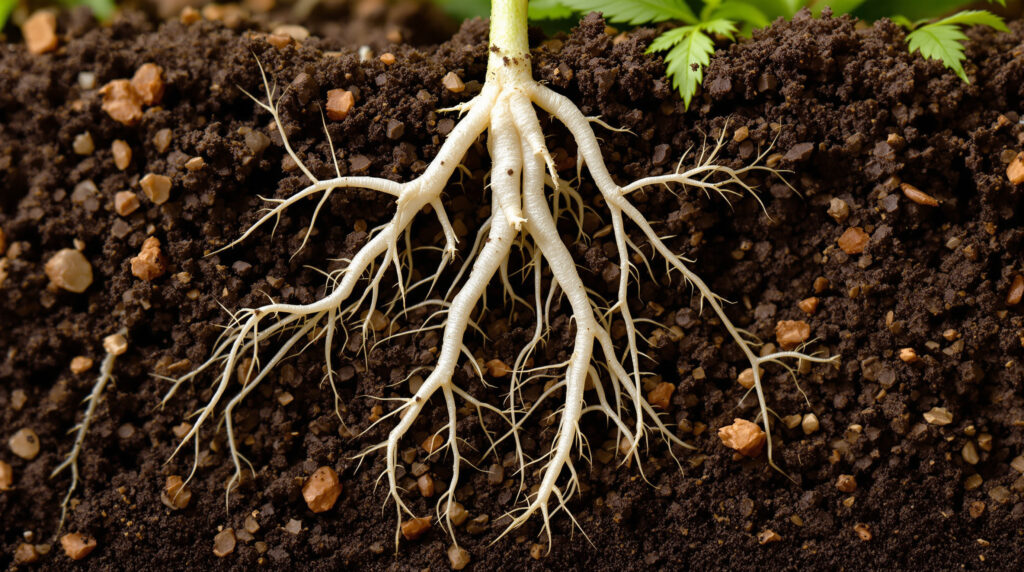
Cannabis roots in living soil with visible mycorrhizal network

Living soil isn’t a single product but an ecosystem in a pot. Ideally, the substrate contains high-quality compost, worm castings, mineral additives like basalt meal or zeolite, organic matter such as neem cake, kelp meal, or bone meal, plus mulch layers and healthy microbial life. The plant releases sugars and amino acids—exudates—through its roots into the soil to attract and feed microorganisms.

In return, bacteria and fungi work for the plant. They decompose organic material and make nitrogen, phosphorus, potassium, and trace elements available as needed. Mycorrhizal fungi play a special role. They form a symbiotic partnership with roots and multiply their reach many times over. Cannabis responds to this fungal partnership with stronger stems, more stable growth, and according to many growers‘ experience reports, more intense aromas as well.

The practical advantage shows itself in daily operation. Once the system is established, you essentially just water with clear water. pH testing, feeding schedules, and pre-harvest flushing are largely unnecessary. Our practical article on living soil setup without fertilizer and pH meter describes in detail how few technical interventions are needed. Organic soils and organic fertilization follow a related logic but are less self-contained than a fully living soil.

The downside lies in preparation. A good living soil needs time to mature—often four to eight weeks—before it really runs smoothly. Pot volume must be generous; fifteen to forty liters per plant is not uncommon. Those wanting to grow high plant counts in tight spaces reach natural limits with this method.

Hydroponics: Precision, speed, and the question of control
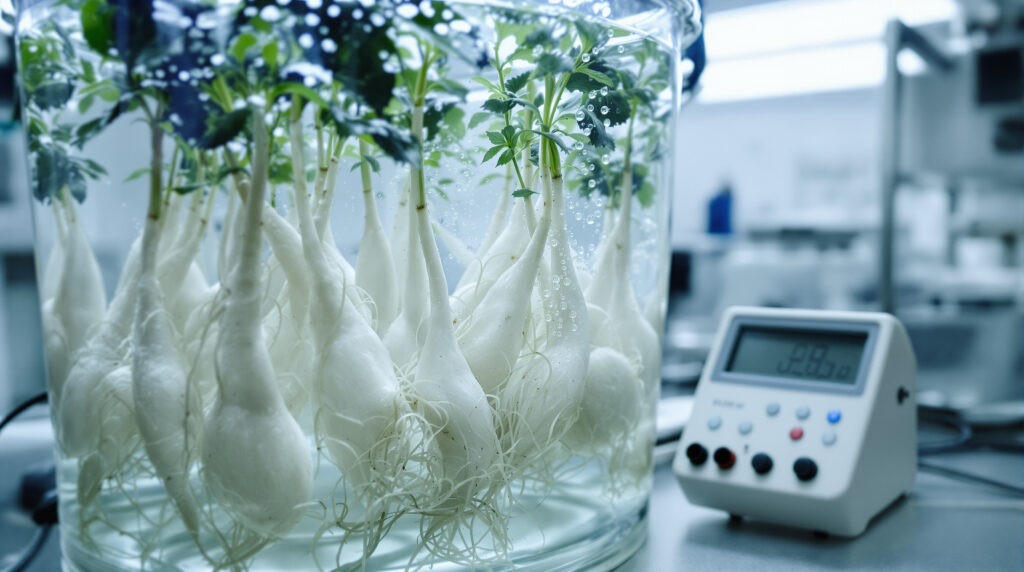
Cannabis roots in hydroponic nutrient solution with measurement and aeration technology

Hydroponics is a collective term for several systems where water and nutrients form the actual growth medium. The best-known variants are Deep Water Culture (DWC), Nutrient Film Technique (NFT), Ebb-and-Flow, and Aeroponics. DWC suspends roots directly in aerated nutrient solution. NFT lets a thin film of nutrient solution flow past the roots. Ebb-and-Flow floods a growing tray at intervals. Aeroponics mists the nutrient solution as fine spray onto freely hanging roots.

All variants share direct nutrient availability at the root. The plant needs no energy to mobilize substances from complex soil. Oxygen is abundant, pH can be adjusted precisely, and nutrient solution conductivity is continuously fine-tuned. Under ideal conditions, this leads to faster root growth, shorter vegetation phases, and larger yields per square meter.

This precision comes at a price. If a pump fails, aeration loses power, or a nozzle clogs in an aeroponic system, roots can suffer serious damage within hours. Aeroponics is most sensitive since roots depend entirely on the spray. DWC forgives short outages better through its water volume. NFT lies somewhere in between.

Those working hydroponically assume full responsibility for every single chemical parameter in the root environment. This requires measuring equipment, maintenance, and a solid understanding of nutrient interactions. System hygiene also matters, as warm nutrient solutions can become a breeding ground for root rot if oxygen supply fails.

Yield, flavor, and cannabinoid profile in direct comparison
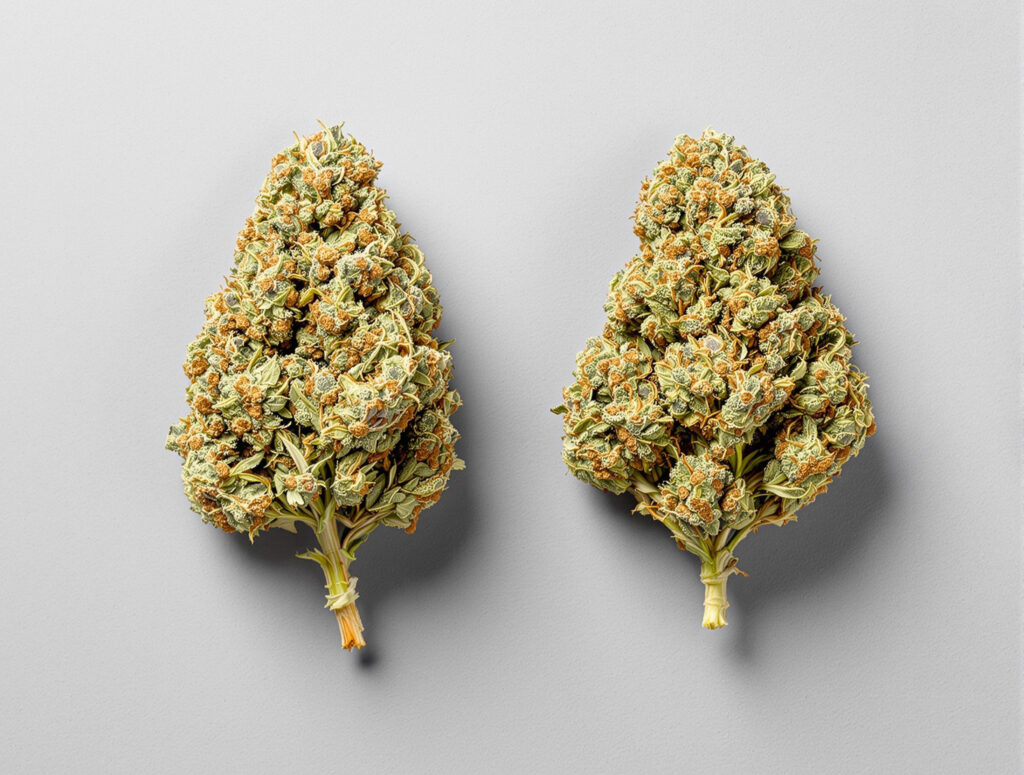
Comparison of two cannabis flowers from living soil and hydroponic cultivation

In pure weight per square meter, hydroponics leads under optimal conditions. Continuous nutrient availability, faster root growth, and shorter vegetation phases deliver measurable yield increases, especially for experienced growers with well-tuned systems. Those needing maximum output on limited space have a clear structural advantage with hydroponics.

The picture shifts with aroma and terpene profile. Many living soil growers report more complex aromas and fuller flavor experiences because the soil microbiome supplies the plant with a broader palette of secondary plant compounds. Sound studies on this point are rare, and advocates of both methods can point to examples supporting their view. Realistically, genetics and environmental conditions like light, temperature, and humidity have greater influence on terpenes than cultivation method alone.

Cannabinoid content shows no consistent differences favoring one method. Both living soil and hydroponically grown plants achieve high THC and CBD values when genetics, light, and climate align. More interesting is the purity question. Living soil works entirely organically and requires no mineral fertilizers. Hydroponic systems depend on salt fertilizers whose residues must be flushed before harvest if a clean, smooth smoking experience is the goal.

Effort, costs, and sustainability: What really differs

Living soil acquisition costs are in the same range as a classic soil setup, with a moderate premium for high-quality additives and soil life. Hydroponic systems start cheap with simple DWC buckets but quickly climb into four- to five-figure territory with NFT troughs, RDWC systems, or true aeroponic setups once measuring and control technology are included.

💬 Hanf-Buddy — dein Cannabis-Experte
🌿 Fragen zu diesem Thema? Schreib einfach los — ich helfe dir!

Bitte verifiziere deine E-Mail. Wir haben dir einen 6-stelligen Code geschickt.

Danke für den Chat! 😊 Abonniere unseren Newsletter für mehr:

Zum Newsletter

In ongoing operation, the ratio partly reverses. Living soil runs on water and occasional organic top-dressings; the soil is reused multiple times and even improves in quality across cycles. Hydroponics constantly demands fresh nutrient solutions, new filters, pump maintenance, and continuous electricity for aeration and circulation.

In sustainability, living soil has structural advantages. The soil remains a living system, organic waste like harvest residues can partly be worked back in, and water consumption is low. Hydroponics uses water very efficiently in closed-loop systems but depends on mineral fertilizers whose production and transport bind CO₂ and energy. Those wanting, like many homegrowers, to keep odor discreet in indoor cultivation, find good solutions in both systems since odor stems primarily from flowering and not from substrate.

Concrete recommendations for 2026: Hardware, substrates, and typical pitfalls

Those starting with living soil should plan generously for pot volume. Twenty to forty liters is a realistic minimum if the plant is to complete the full cycle without repotting. A well-considered base consists of mature compost, worm castings, coconut-containing or purely earth-based substrate framework, basalt meal, and a mix of neem cake, kelp meal, and plant meal as a slow nitrogen source. A mulch layer of straw or clover protects soil life from drying out and continuously supplies fresh material.

With hydroponics, a simple Deep Water Culture setup is recommended for beginners, with well-sized air pump, high-quality rockwool or clay pellet plant anchors, and reliable EC and pH meters. Those scaling up switch sooner to RDWC or Ebb-and-Flow where multiple plants can be supplied via a shared tank. Aeroponics initially remains for professionals since every clogged nozzle becomes an acute threat to roots.

Typical pitfalls differ in both worlds. With living soil, many growers fail by using soil that’s too young or too dry where the microbial life hasn’t yet established. Patience during maturation, good water quality, and consistently avoiding chlorinated tap water directly from the faucet are decisive here. With hydroponics, problems revolve around nutrient drift, fluctuating pH, and root rot from overly warm or poorly aerated nutrient solutions.

Which method suits which grower?

For beginners without prior experience, living soil is the more robust choice. Once you’ve built a good soil, you can withstand rough watering rhythm errors and minor climate swings without drama. The learning path focuses on understanding the plant rather than mastering measuring devices. Even those with little time for regular maintenance get along more easily with living soil.

For ambitious growers wanting maximum yield with short cycles, hydroponics is the logical choice. Those already willing to dive into feeding schedules, EC values, and water chemistry gain speed, scalability, and reproducibility with a hydroponic system. This is especially true when multiple plants should grow under standardized conditions and results must be comparable between cycles.

For a philosophical decision, a simple test applies. Those seeing the plant first as a living being and understanding cultivation as relationship will find living soil closer. Those seeing the plant first as a system and understanding cultivation as controlled procedure will feel at home in hydroponics faster. Both paths lead to excellent cannabis; they simply demand different kinds of attention. Deeper insights into regenerative philosophy are provided by our article on living soil and anarchic growing.

Frequently asked questions

Which method is cheaper in the long run?

Living soil is often cheaper long-term because the soil is reused multiple times and fed with organic top-dressings. Hydroponics has lower entry costs for simple systems but constantly requires fresh nutrient salts, electricity for pumps and aeration, and regular equipment maintenance.

Does cannabis from living soil really taste better?

Many growers describe the aroma as more complex and rounded; definitive scientific evidence is lacking, however. The larger influence factor on terpene profile remains genetics, closely followed by light, temperature, and humidity during flowering and drying. Living soil can support this framework but doesn’t replace good conditions. The therapeutic role terpenes play beyond aroma is shown in our overview of pain relief through terpenes in chemotherapy.

Which hydroponics variant suits beginners?

Deep Water Culture is the most beginner-friendly variant because water volume buffers short pump failures and setup remains manageable. NFT and aeroponics deliver more at their peak but forgive few errors and only suit those with a few cycles of experience with nutrient solutions and hygiene. Those wanting to examine living soil, hydroponics, and rockwool side-by-side find additional practical insights in the debunking of common cultivation myths by Lorenz Minks.

Do I need additional fertilizer for living soil?

In a well-built living soil with high-quality compost, worm castings, and mineral additives, no classical fertilizer is needed. Top-dressings with organic components like kelp meal, neem cake, or bone meal suffice to supply the soil life across multiple cycles.

Which method is more sustainable?

Living soil has structural advantages because the soil remains a living system, water is used sparingly, and no mineral fertilizers need purchasing. Hydroponics can use water very efficiently in closed loops but depends on industrial salt fertilizers whose production binds energy and raw materials.

Can I combine living soil and hydroponics in the same tent?

📊 Deine Meinung zählt

Welche Anbaumethode nutzt du oder interessiert dich am meisten?

✓
Danke für deine Stimme!

Technically possible, practically awkward. Both methods demand different watering and feeding cycles, varying pot sizes, and sometimes different climate profiles. Those wanting to try both approaches do better with separate areas or time-staggered cycles than with a mixed setup in the same space.


Kannabia
HE Abverkauf
Dr. Mang
GrowTechnology – Left
MedCanOneStop
Khalifa Genetics
Grow Technology – Right
Royal Queen Seeds #1

Das könnte dich auch interessieren

  • → Die richtige Marihuanalagerung zum Qualitätserhalt
  • → Welche Hanfpflanze enthält THC?
  • → CSC Hamburg probt Cannabisernte mit THC-freien Sorten

Branchen-Update

News, Analysen und Reportagen — mehrmals im Monat direkt in dein Postfach.

Folge uns

Was dich auch interessieren könnte...

Indoor-Growzelt mit LED-Beleuchtung und Cannabis-Pflanzen in Stofftöpfen

Indoor Cannabis Anbau: Der komplette Guide 2026

11. Juni 2026
Cannabiswurzeln in lebendigem Boden mit Mykorrhiza-Pilzfäden

Living Soil: Der ultimative Guide für organischen Cannabis-Anbau

18. Mai 2026
InstagramYouTubeFacebookLinkedIn
Tags: HomegrowHydroponikIndoor GrowLiving SoilMykorrhizaNachhaltigkeitTerpene

Related Posts

Indoor-Growzelt mit LED-Beleuchtung und Cannabis-Pflanzen in Stofftöpfen
Indoor-Growing für Anfänger & Profis

Indoor Cannabis Anbau: Der komplette Guide 2026

von Mara König
11. Juni 2026
Hanfsamen in Nahaufnahme mit typischer marmorierter Musterung
Lebensmittel aus Hanf

Hanfsamen: Nährstoffprofil, Anwendung und die besten Produkte

von Mara König
10. Juni 2026
🛠️ Tool-Tipp
💨Vaporizer-Temperatur
Welche Temperatur für welchen Effekt
→ Alle 10 Tools im Werkzeugkasten

Folge uns bei:

  • 38.8k Fans
  • 52.8k Followers
  • 3.5k Followers
  • 573 Followers
  • 2.7k Abonnenten
📰

Seit 2015

📝

4646+ Artikel

👥

180.000+ Leser/Monat

🏆

DACH #1 Cannabis-Magazin

Über uns

Hanf Magazin ist das führende deutschsprachige Fachmagazin für Cannabis — von der Pflanze bis zur Politik, von der Medizin bis zum Genuss.

Instagram YouTube Facebook LinkedIn

Themen

Cannabis News Medizin & Forschung Growing & Anbau Strain Reviews Nutzhanf & Rohstoffe Konsum & Rezepte Recht & Politik Wissenschaft & Studien

Beliebte Artikel

Vollspektrum-Hanf-Harz mit „CBX“: Was hinter den angeblich legalen Produkten stecktWie vaporisiere ich richtig?Warum Vaporisieren gesünder istWas ist Cannabidiol?Kiffen in der Schwangerschaft?

Branchen-Update

Cannabis-News direkt in dein Postfach.

Für Unternehmen

Werben auf Hanf Magazin Mediadaten HM Ventures Jobs & Karriere Tools & Rechner

Weitere Themen

  • Kolumnen
  • 🎉 MJ Berlin 2026
  • Hanf Allgemein
  • Drogenkunde
  • Produkte
  • Strain Reviews
  • Print Magazin
  • Tools

© 2026 Hanf Magazin

Impressum Datenschutz AGB Kontakt Presse
WhatsAppFacebookXE-Mail
No Result
View All Result
  • News
  • Medizin
    • Cannabinoide
    • Erkrankungen
    • Cannabis bei Tieren
    • Erfahrungsberichte
  • Recht & Politik
    • Deutschland
    • Österreich
    • Schweiz
    • International
    • Rechtslage DE
    • Rechtslage International
  • Wissenschaft
    • Studien
    • Forschung
  • Growing
    • Indoor-Growing
    • Outdoor-Growing
    • Strains & Reviews
    • Equipment
  • Nutzhanf
    • Baustoffe
    • Rohstoffe
    • Lebensmittel
    • Kleidung
    • Kosmetika
  • Wirtschaft
  • Konsum & Lifestyle
    • Rauchen
    • Vaporisieren
    • Essen & Rezepte
    • Kultur & Szene
    • Termine & Events
  • Kolumnen
  • 🎉 MJ Berlin 2026
  • Interviews
  • Hanf Allgemein
  • Gesellschaft & Soziales
  • Drogenkunde
  • Safer Use
  • Pflanzliche Drogen
  • Produkte
  • Strain Reviews
  • Print Magazin
  • Tools

©2026 Hanf Magazin

Datenschutz-Einstellung

Wir nutzen Cookies auf hanf-magazin.com. Einige von ihnen sind essenziell notwendig, andere helfen unsere Website und deine Nutzer-Erfahrungen zu verbessern. Wenn Sie unter 16 Jahre alt sind und Ihre Zustimmung zu freiwilligen Diensten geben möchten, müssen Sie Ihre Erziehungsberechtigten um Erlaubnis bitten. Wir verwenden Cookies und andere Technologien auf unserer Website. Einige von ihnen sind essenziell, während andere uns helfen, diese Website und Ihre Erfahrung zu verbessern. Personenbezogene Daten können verarbeitet werden (z. B. IP-Adressen), z. B. für personalisierte Anzeigen und Inhalte oder Anzeigen- und Inhaltsmessung. Weitere Informationen über die Verwendung Ihrer Daten finden Sie in unserer Datenschutzerklärung. Sie können Ihre Auswahl jederzeit unter Einstellungen widerrufen oder anpassen.

  • Essenziell
  • Marketing
  • Externe Medien

Alle akzeptieren

Nur essenzielle Cookies akzeptieren

Individuelle Datenschutzeinstellungen

Cookie-Details Datenschutzerklärung Impressum

Datenschutzeinstellungen Datenschutzeinstellungen

Wenn Sie unter 16 Jahre alt sind und Ihre Zustimmung zu freiwilligen Diensten geben möchten, müssen Sie Ihre Erziehungsberechtigten um Erlaubnis bitten. Wir verwenden Cookies und andere Technologien auf unserer Website. Einige von ihnen sind essenziell, während andere uns helfen, diese Website und Ihre Erfahrung zu verbessern. Personenbezogene Daten können verarbeitet werden (z. B. IP-Adressen), z. B. für personalisierte Anzeigen und Inhalte oder Anzeigen- und Inhaltsmessung. Weitere Informationen über die Verwendung Ihrer Daten finden Sie in unserer Datenschutzerklärung. Hier finden Sie eine Übersicht über alle verwendeten Cookies. Sie können Ihre Einwilligung zu ganzen Kategorien geben oder sich weitere Informationen anzeigen lassen und so nur bestimmte Cookies auswählen.

Alle akzeptieren Speichern Nur essenzielle Cookies akzeptieren

Zurück

Datenschutzeinstellungen

Essenzielle Cookies ermöglichen grundlegende Funktionen und sind für die einwandfreie Funktion der Website erforderlich.

Cookie-Informationen anzeigen Cookie-Informationen ausblenden

Name
AnbieterEigentümer dieser Website, Impressum
ZweckSpeichert die Einstellungen der Besucher, die in der Cookie Box von Borlabs Cookie ausgewählt wurden.
Cookie Nameborlabs-cookie
Cookie Laufzeit1 Jahr

Marketing-Cookies werden von Drittanbietern oder Publishern verwendet, um personalisierte Werbung anzuzeigen. Sie tun dies, indem sie Besucher über Websites hinweg verfolgen.

Cookie-Informationen anzeigen Cookie-Informationen ausblenden

Akzeptieren
Name
AnbieterGoogle Ireland Limited, Gordon House, Barrow Street, Dublin 4, Ireland
ZweckCookie von Google für Website-Analysen. Erzeugt statistische Daten darüber, wie der Besucher die Website nutzt.
Datenschutzerklärung https://policies.google.com/privacy?hl=de
Cookie Name_ga,_gat,_gid
Cookie Laufzeit2 Jahre

Inhalte von Videoplattformen und Social-Media-Plattformen werden standardmäßig blockiert. Wenn Cookies von externen Medien akzeptiert werden, bedarf der Zugriff auf diese Inhalte keiner manuellen Einwilligung mehr.

Cookie-Informationen anzeigen Cookie-Informationen ausblenden

Akzeptieren
Name
AnbieterMeta Platforms Ireland Limited, 4 Grand Canal Square, Dublin 2, Ireland
ZweckWird verwendet, um Facebook-Inhalte zu entsperren.
Datenschutzerklärung https://www.facebook.com/privacy/explanation
Host(s).facebook.com
Akzeptieren
Name
AnbieterSoundcloud
ZweckWird verwendet, um Soundcloud Inhalte zu entsperren.
Datenschutzerklärung https://soundcloud.com/pages/privacy
Host(s)soundcloud.com
Akzeptieren
Name
AnbieterMeta Platforms Ireland Limited, 4 Grand Canal Square, Dublin 2, Ireland
ZweckWird verwendet, um Instagram-Inhalte zu entsperren.
Datenschutzerklärung https://help.instagram.com/519522125107875/?maybe_redirect_pol=0
Host(s).instagram.com
Cookie Namepigeon_state
Cookie LaufzeitSitzung

Datenschutzerklärung Impressum

AC Infinity – Header
Kannabia
HE Abverkauf
Dr. Mang
GrowTechnology – Left
MedCanOneStop
Khalifa Genetics
Grow Technology – Right
Royal Queen Seeds #1

Mehr aus Indoor-Growing für Anfänger & Profis

  • Indoor Cannabis Anbau: Der komplette Guide 2026

    Indoor Cannabis Anbau: Der komplette Guide 2026

    11.06.2026 — Mara König
  • Living Soil: Der ultimative Guide für organischen Cannabis-Anbau

    Living Soil: Der ultimative Guide für organischen Cannabis-Anbau

    18.05.2026 — Leo Hartmann
  • Cannabis-Schädlinge und Krankheiten: erkennen und bekämpfen

    Cannabis-Schädlinge und Krankheiten: erkennen und bekämpfen

    08.05.2026 — Mara König
  • Geruch beim Indoor-Anbau: So hältst du deinen Homegrow diskret

    Geruch beim Indoor-Anbau: So hältst du deinen Homegrow diskret

    08.05.2026 — Christian Schäfer
  • Daily Light Integral (DLI) bei Cannabis: Die wichtigste Lichtkennzahl erklärt

    Daily Light Integral (DLI) bei Cannabis: Die wichtigste Lichtkennzahl erklärt

    01.05.2026 — Leo Hartmann

Beliebte Artikel

  • Cannabis-Genetik erklärt: F1, F2, BX und was sie bedeuten

    Cannabis-Genetik erklärt: F1, F2, BX und was sie bedeuten

    07.06.2026 — Jonas Reuter
  • Bayern blockiert Cannabis-Anbau: Hanfverband und CSC Inntal klagen

    Bayern blockiert Cannabis-Anbau: Hanfverband und CSC Inntal klagen

    13.06.2026 — Christian Schäfer
  • Eine Tonne Cannabis, Goldbarren, eine Glock: Was der Rekordfund in Wien-Liesing über Österreichs Verbotspolitik verrät

    Eine Tonne Cannabis, Goldbarren, eine Glock: Was der Rekordfund in Wien-Liesing über Österreichs Verbotspolitik verrät

    11.06.2026 — Leo Hartmann
  • Cannabis und Psychosen: Mythen, Fakten und Risikogruppen

    Cannabis und Psychosen: Mythen, Fakten und Risikogruppen

    05.06.2026 — Mara König
  • Cannabinoide gegen Glioblastom und Brustkrebs: Budapester Meta-Analyse zeigt konsistente Anti-Tumor-Effekte

    Cannabinoide gegen Glioblastom und Brustkrebs: Budapester Meta-Analyse zeigt konsistente Anti-Tumor-Effekte

    03.06.2026 — Mara König

Aktuelle News

  • Bayern blockiert Cannabis-Anbau: Hanfverband und CSC Inntal klagen

    Bayern blockiert Cannabis-Anbau: Hanfverband und CSC Inntal klagen

    13.06.2026 — Christian Schäfer
  • VER-01 von Vertanical: FDA-Breakthrough-Status für Cannabis-Schmerzmittel aus München

    VER-01 von Vertanical: FDA-Breakthrough-Status für Cannabis-Schmerzmittel aus München

    05.06.2026 — Leo Hartmann
  • Alsdorfer Lunte: Unter 2 Euro pro Gramm, MwSt-Klage, KI im Backend

    Alsdorfer Lunte: Unter 2 Euro pro Gramm, MwSt-Klage, KI im Backend

    03.06.2026 — Christian Schäfer
  • Schweizer Cannabis-Regulierung: IG Hanf fordert Tempo statt Verzögerung

    Schweizer Cannabis-Regulierung: IG Hanf fordert Tempo statt Verzögerung

    13.05.2026 — Christian Schäfer
  • DIW-Studie: Cannabis bleibt stabil – Kokain ist auf das Vierfache gestiegen

    DIW-Studie: Cannabis bleibt stabil – Kokain ist auf das Vierfache gestiegen

    12.05.2026 — Christian Schäfer
  • 9 Jahre CBD VITAL: Erkenntnisse aus über 1 Million Kundenstimmen

    9 Jahre CBD VITAL: Erkenntnisse aus über 1 Million Kundenstimmen

    05.05.2026 — Lucas Nestler
  • Cannabis-Medizin 2026: Bilanz vom dritten Circle of Experts in Paderborn

    Cannabis-Medizin 2026: Bilanz vom dritten Circle of Experts in Paderborn

    03.05.2026 — Mara König
  • Wie viele Cannabis-Clubs gibt es in Deutschland? Warum die Zahlen weit auseinandergehen

    Wie viele Cannabis-Clubs gibt es in Deutschland? Warum die Zahlen weit auseinandergehen

    30.04.2026 — Christian Schäfer

Produktvorstellungen

  • Wenn Aktivkohle auf Tip-Gefühl trifft

    Wenn Aktivkohle auf Tip-Gefühl trifft

    03.02.2026 — Christian Schäfer
  • „Warum wir wieder Boxen machen“ – der Hanf Magazin Shop

    „Warum wir wieder Boxen machen“ – der Hanf Magazin Shop

    15.01.2026 — Leo Hartmann
  • AirVape Legacy Pro 2 – Der Klassiker neu definiert

    AirVape Legacy Pro 2 – Der Klassiker neu definiert

    29.10.2025 — Dieter Klaus Glasmann
  • Der Begleiter für dein Wohlbefinden - Hanfosan CBD-Öl 10 %

    Der Begleiter für dein Wohlbefinden - Hanfosan CBD-Öl 10 %

    09.07.2025 — Dieter Klaus Glasmann
  • Kontrolle über Körper und Geist - Renact REST und RELIEF

    Kontrolle über Körper und Geist - Renact REST und RELIEF

    06.06.2025 — Dieter Klaus Glasmann
🇩🇪 Deutsch 🇬🇧 English ✓ 🇪🇸 Español 🇫🇷 Français 🇧🇷 Português 🇮🇹 Italiano 🇵🇱 Polski 🇹🇷 Türkçe 🇳🇱 Nederlands 🇨🇿 Čeština 🇯🇵 日本語 🇰🇷 한국어 🇷🇺 Русский 🇸🇦 العربية 🇹🇭 ไทย 🇮🇳 हिन्दी