• Kolumnen
    • Interviews
  • 🎉 MJ Berlin 2026
  • Hanf Allgemein
    • Gesellschaft & Soziales
  • Drogenkunde
    • Safer Use
    • Pflanzliche Drogen
  • Produkte
  • Strain Reviews
  • Print Magazin
  • Tools
Montag, Juni 15, 2026
Hanf Magazin
  • News
  • Medizin
    • Cannabinoide
    • Erkrankungen
    • Cannabis bei Tieren
    • Erfahrungsberichte
  • Recht & Politik
    • Deutschland
    • Österreich
    • Schweiz
    • International
    • Rechtslage DE
    • Rechtslage International
  • Wissenschaft
    • Studien
    • Forschung
  • Growing
    • Indoor-Growing
    • Outdoor-Growing
    • Strains & Reviews
    • Equipment
  • Nutzhanf
    • Baustoffe
    • Rohstoffe
    • Lebensmittel
    • Kleidung
    • Kosmetika
  • Wirtschaft
  • Konsum & Lifestyle
    • Rauchen
    • Vaporisieren
    • Essen & Rezepte
    • Kultur & Szene
    • Termine & Events
No Result
View All Result
  • News
  • Medizin
    • Cannabinoide
    • Erkrankungen
    • Cannabis bei Tieren
    • Erfahrungsberichte
  • Recht & Politik
    • Deutschland
    • Österreich
    • Schweiz
    • International
    • Rechtslage DE
    • Rechtslage International
  • Wissenschaft
    • Studien
    • Forschung
  • Growing
    • Indoor-Growing
    • Outdoor-Growing
    • Strains & Reviews
    • Equipment
  • Nutzhanf
    • Baustoffe
    • Rohstoffe
    • Lebensmittel
    • Kleidung
    • Kosmetika
  • Wirtschaft
  • Konsum & Lifestyle
    • Rauchen
    • Vaporisieren
    • Essen & Rezepte
    • Kultur & Szene
    • Termine & Events
No Result
View All Result
Hanf Magazin
No Result
View All Result
Home Marihuana Growing Indoor-Growing für Anfänger & Profis

Living Soil: The Ultimate Guide to Organic Cannabis Cultivation

von Leo Hartmann
18.05.2026
in Indoor-Growing für Anfänger & Profis
Lesezeit: 8 Minuten
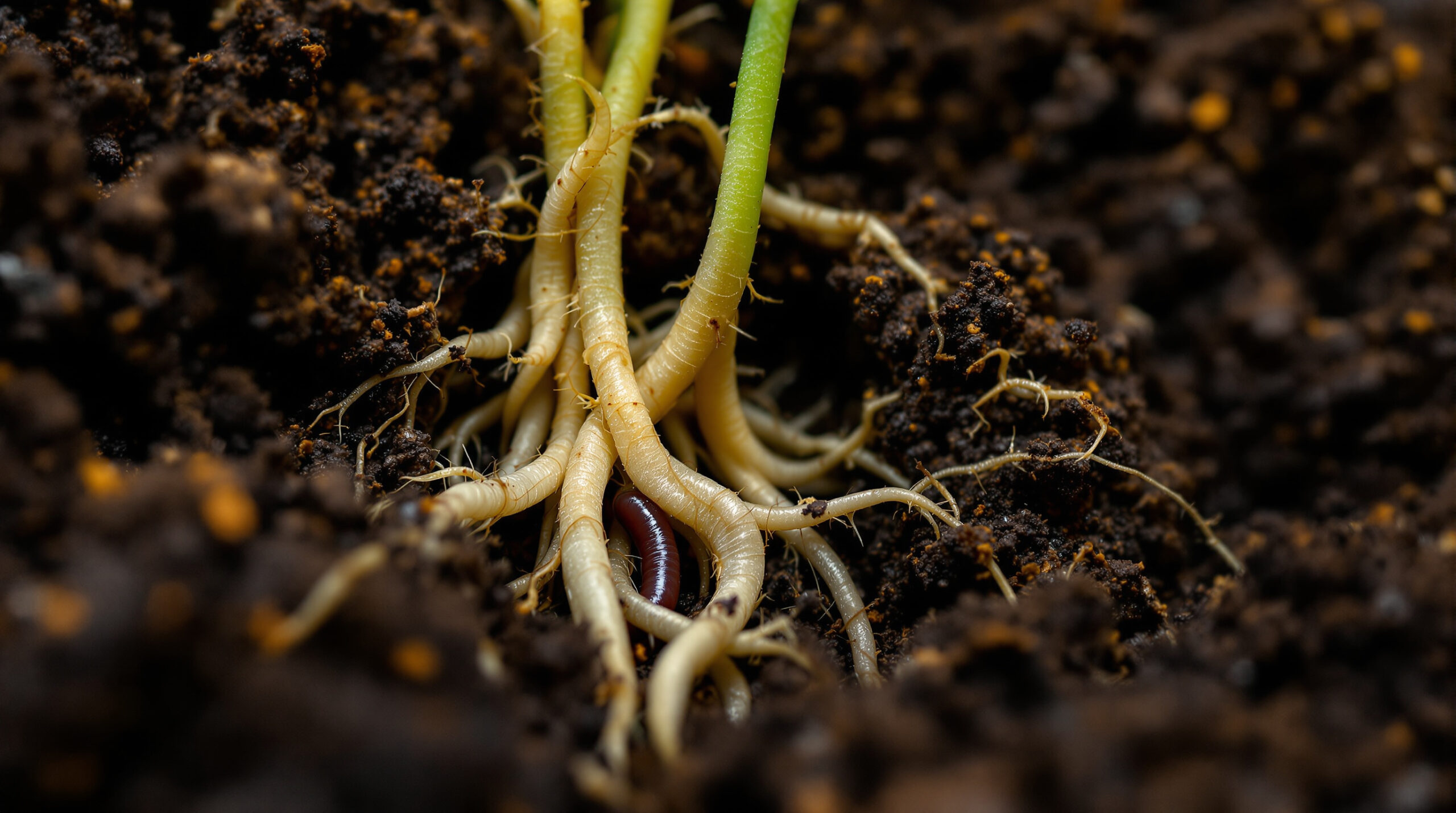
Cannabiswurzeln in lebendigem Boden mit Mykorrhiza-Pilzfäden
⏱ 11 Min. Lesezeit·2.012 Wörter
Teilen:WhatsAppFacebookXLinkedInE-Mail
🌐 This article was automatically translated from German. Browse all English articles

Living Soil has become shorthand in cannabis cultivation for an entire philosophy. When you hear the term, you think not just of organic soil, but of a living micro-ecosystem that nourishes the plant, protects it, and shapes its aroma. Instead of individual fertilizer applications, a dense network of bacteria, fungi, protozoa, and soil fauna takes over root nutrition in Living Soil. The grower transforms from a mineral fertilizer mixer into a gardener of a small soil cycle that becomes more stable with each growing season.

📑 Inhaltsverzeichnis

  1. What Living Soil Distinguishes from Ordinary Cannabis Soil
  2. The Recipe: What Ingredients a Living Soil Needs
  3. Soil Food Web: Who Works in Living Soil?
  4. Setup and Cycling: Establishing Living Soil in Practice
  5. Ongoing Care: Compost Tea, Mulch, and No-Till
  6. Common Mistakes and How Living Soil Actually Pays Off
  7. Frequently Asked Questions
  8. 💬 Fragen? Frag den Hanf-Buddy!

This guide shows how Living Soil works, what ingredients a resilient mix needs, how the substrate breaks in, and what maintenance is actually necessary during ongoing operation. The perspective is that of a German-speaking home grower following cannabis legalization who wants to build his legal home cultivation with conscious ecological principles. That this approach requires patience belongs in an honest assessment.

What Living Soil Distinguishes from Ordinary Cannabis Soil

Conventional substrates from grow shops are typically designed for a specific number of weeks. Peat or coco form the structure, a reserve of mineral or easily soluble organic nutrients supplies the nourishment. Once this reserve is depleted, the phase begins where the grower themselves doses: NPK solutions, micronutrients, pH correction. In this model, the soil is a passive carrier medium whose function is limited to water storage and root anchoring.


GanjaFarmerGanjaFarmer

Living Soil shifts these roles. The substrate is itself active here because a calculated microbiology works within it. Root exudates of sugars and amino acids attract beneficial microbes, which in turn break down organic matter and pass mineralized nutrients to the root. The plant thereby controls itself which substances become available and when. Overfeeding becomes unlikely because no salts hang in high concentrations in the water, but rather nutrients are bound in organic material and released through biological activity.

A second difference lies in reusability. While classic soils are often disposed of after one grow, Living Soil can run for many cycles as long as the organic matter and soil life are regularly refreshed through mulch, compost tea, and top-dressings. We’ve already described the principle in the background article No Fertilizer, No pH Measuring: How to Succeed with Living Soil Cannabis, which summarizes the core philosophy concisely.

The Recipe: What Ingredients a Living Soil Needs
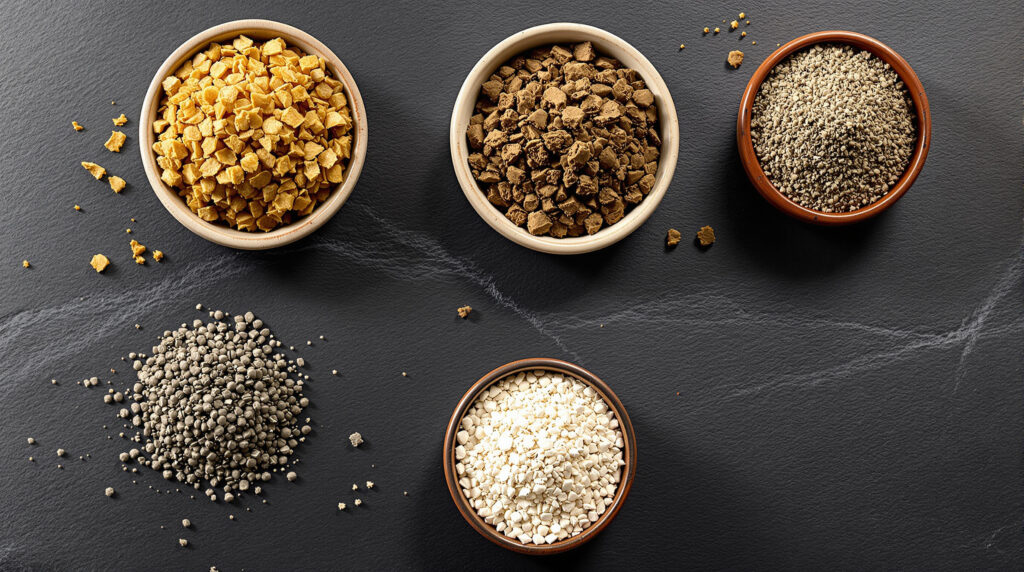
Living Soil ingredients arranged in bowls: peat, compost, rock dust

A resilient Living Soil mix stands on three pillars: base material, organic amendments, and structural components for aeration. The base material supplies water retention capacity and organic matter. In practice, a combination of sphagnum peat or coco chips with high-quality, well-aged compost has proven effective. Those who avoid peat for ecological reasons can rely on coco and compost, but should then pay closer attention to calcium and pH.

The organic amendments supply the actual nutrients. Worm castings are the centerpiece here because they bring very high microbial density and carry nitrogen, phosphorus, and trace elements in plant-available form. This is supplemented by classic components: horn meal or plant-based nitrogen from alfalfa meal, bone meal or phosphate rock meal as phosphorus sources, potassium suppliers like kelp meal or potassium sulfate, and rock powders as sources for micronutrients and slowly available silicon. Dolomite or algal limestone buffer the pH value and provide calcium and magnesium.

The third pillar is structure. Cannabis likes a mixture of high water retention and simultaneously good drainage. Perlite, pumice, or rice hull husks keep the mix loose and ensure that roots receive oxygen without the substrate compacting under its own weight in pots. As a rule of thumb, a ratio of one part compost, one part peat or coco, and one part aeration has proven effective. The amendments go into this basic framework, usually in the range of one to two cups per 50 liters of mix, depending on the specific product.

Soil Food Web: Who Works in Living Soil?

Microscopic image of soil life with bacteria and fungal hyphae

The concept of the Soil Food Web stems from soil science and describes the food chain within an active substrate. At the beginning are bacteria and fungi that break down organic material. Bacteria work rather in younger, nitrogen-rich substrates, while fungi dominate in more mature, carbon-rich systems with plenty of mulch. Cannabis benefits throughout its cycle from a mixed microbial community that is bacterially dominated in the vegetative phase and increasingly fungal during flowering.

Mycorrhizal fungi play a special role. They form a true symbiosis with the root and extend the effective root surface many times over. This allows the plant to reach distant water and phosphate reserves and better withstand minor dry periods. Bacteria from the rhizosphere, meaning the direct environment around the root, dissolve mineral phosphate and fix atmospheric nitrogen. Higher in the food chain are protozoa and nematodes, which in turn feed on bacteria and excrete nitrogen in plant-available form. We’ve detailed this cast of characters more thoroughly in the article Beneficial Microorganisms in Hemp Cultivation.

For the grower, this means two things. First, the soil needs carbon sources like mulch so the microbiology doesn’t starve. Second, harsh interventions like sharp pH-Down, chlorine-containing tap water, or synthetic fungicides harm this system noticeably. Those working in Living Soil therefore water with settled or filtered water whenever possible and avoid interventions that broadly weaken soil life.

Setup and Cycling: Establishing Living Soil in Practice

A freshly mixed Living Soil is not yet a finished substrate. The amendments must first be broken down microbiologically, otherwise the plant risks overfeeding from unbound nitrogen in the early vegetative phase. This break-in phase is called Cycling in English-speaking practice. In practice, it means the mixed soil is stored moist and warm for two to six weeks before the first plants move in.

During cycling, nutrients from coarse meals migrate into microbial biomass and subsequently become available in controlled doses. Practically, a bulk amount of mix in large containers or fabric bags stored at room temperature, lightly moistened once a week with lukewarm water, often suffices. A good indicator of successful cycling is an earthy, slightly forest-like smell after about four weeks. Sharp ammonia notes instead point to anaerobic conditions—here the mix needs to be loosened and remixed.

Once the soil is broken in, the plants move in. Pot size is significantly more relevant in Living Soil than in mineral fertilizer setups. A 30 to 50-liter container is a good benchmark for a single photoperiod plant because the volume provides stable microbiology and buffer capacity. Smaller pots also work but forgive fewer care mistakes. Those wanting to work with less volume will find an overview of cost-saving alternatives in the article Sustainable Cannabis Cultivation: Home Growing Ecological and Cost-Effective Optimization.

Ongoing Care: Compost Tea, Mulch, and No-Till
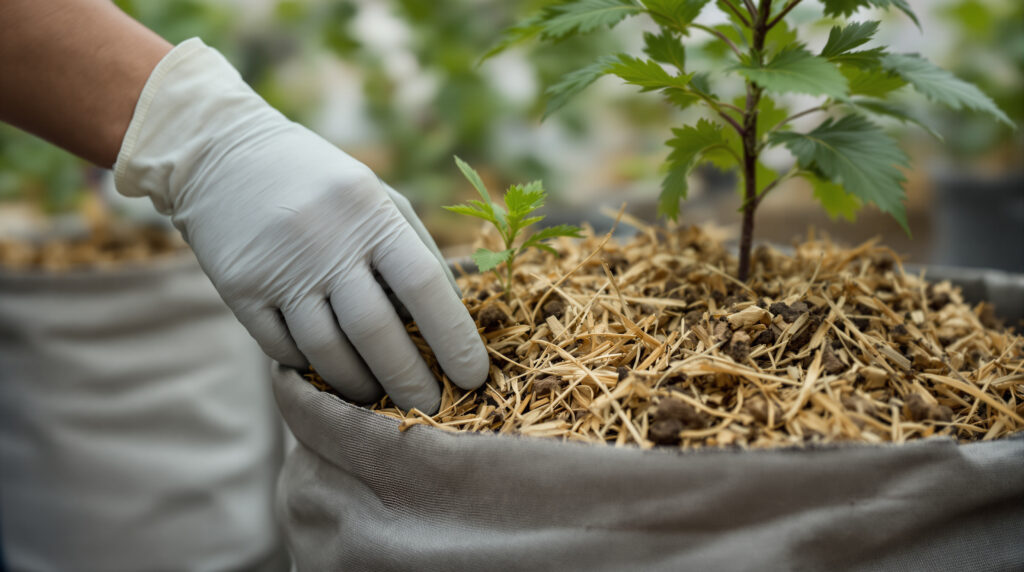
Hands distribute organic mulch layer on cannabis pot surface

The ongoing care of Living Soil is surprisingly simple. Instead of a weekly feeding schedule, irrigation water becomes the focal point, supplemented by a few targeted interventions. Compost tea plays a central role—an aerated infusion of worm castings, a small amount of molasses as microbial food, and water. Within 24 to 36 hours, bacteria and fungi multiply at high density and are subsequently applied directly to the pot. Compost tea is not a fertilizer in the classical sense, but rather a microbial inoculant that nurtures soil life.

💬 Hanf-Buddy — dein Cannabis-Experte
🌿 Fragen zu diesem Thema? Schreib einfach los — ich helfe dir!

Bitte verifiziere deine E-Mail. Wir haben dir einen 6-stelligen Code geschickt.

Danke für den Chat! 😊 Abonniere unseren Newsletter für mehr:

Zum Newsletter

The tea is supplemented by a mulch layer on the pot surface. Straw, wood chips, or chopped clover and alfalfa plants retain moisture, buffer temperature swings, and provide slowly decomposing carbon for fungi in the substrate. This cover-crop idea fits very well into the Living Soil paradigm because it keeps the soil in a state it also assumes in nature: never bare, always covered.

The No-Till principle means not turning the substrate between cycles. Instead of ripping out the old root ball, the grower cuts the stem just above ground level and leaves the roots in the pot as organic material, where they decompose into humus. Then top-dressings of worm castings and a small amount of meals go on top, the mulch is refreshed, and after a few days‘ pause the next seedling moves in. With each cycle the soil matures further, buffer capacity increases, and plants typically need less attention. How closely this logic relates to permaculture ideas is described in the article High-End Through Permaculture: Cannabis in Harmony with Nature.

Common Mistakes and How Living Soil Actually Pays Off

Living Soil forgives much, but not everything. The most common mistake is impatience. Those stocking freshly mixed, uncycled soil directly with seedlings often see burned leaf edges in the second or third week because active meals release nitrogen before the plant can process it. The solution is not stronger flushing, but giving the cycle time or working with smaller initial amendments.

A second risk is wrong watering. Living Soil likes consistent, moderate moisture. Those alternating between drying out and flooding risk anaerobic zones at the pot bottom where soil life collapses. Fabric pots, good drainage through aeration, and the principle of watering more frequently in smaller amounts help here. The water itself deserves attention too: chlorinated tap water should stand open for at least 24 hours to let chlorine escape, or pass through a simple activated charcoal filter.

Economically, Living Soil pays off medium-term. The first fill is more expensive than a bag of standard soil because worm castings, compost, rock meals, and amendments are one-time costs. From the second cycle onward, however, the effort drops significantly because only top-dressings and mulch need to be added. Over three to five cycles, the cost per plant lands in a similar range as classical setups, with the bonus that no salt fertilizers need disposal and no pH probes need calibration. Those who want to think about cultivation additionally in a purist fashion will find a very radical approach in Living Soil and Anarchy Growing: The Revolution of Cannabis Cultivation.

Frequently Asked Questions

Do I need pH and EC meters when working with Living Soil?

In stable Living Soil, measuring instruments are significantly less important than in a setup with salt fertilizers. The soil buffers pH largely on its own through organic matter and lime components, and there is no growing salt concentration that would need to be monitored via EC. Those wanting certainty can occasionally measure the juice of a small substrate infusion, but this isn’t necessary weekly. More important is observing the plant and the moisture progression in the pot.

Does Living Soil also work in autoflower setups?

Autoflower plants are somewhat less flexible in Living Soil because they lack a long vegetative phase for soil life to develop. Well-cycled soil is therefore nearly mandatory for autos, benign amendments should dominate, and worm castings provide the bulk of early-phase nutrients. Those observing this can achieve very clean results even with auto genetics, but particularly in photoperiod operation benefit from the full Living Soil logic.

How long does a Living Soil pot last before it needs replacing?

With good care through top-dressings, mulch, and occasional compost teas, Living Soil pots often run through many cycles, with setups described in practice that remain productive after three or four years. What’s crucial is that organic matter is replenished and the substrate doesn’t compact. With visible structure loss or root problems, the mix can be refreshed with fresh aeration and compost rather than completely replaced.

What role does compost tea play in ongoing operation?

In Living Soil, compost tea is less a fertilizer than a microbial booster. It delivers high concentrations of aerobic bacteria and fungi to the substrate in a short time and thereby strengthens the rhizosphere. During weak phases—for instance after stress, in early flowering, or after a change—a tea helps quickly reactivate soil life. As an ongoing program, one application every two to four weeks suffices.

Is Living Soil compatible with German cannabis law?

Living Soil concerns the cultivation method, not legal classification. As long as home cultivation remains within the cannabis law framework—meaning permitted plant numbers, quantity limits, and child-safety regulations—the choice of substrate is free. Living Soil has the advantage here that no concentrated fertilizers need be stored in the household, making cultivation overall more family-friendly.

More Articles on This Topic

  • Cannabis Pests and Diseases: Recognize and Control
  • Fabulous Profits in a Fairy-Tale Castle – DoktorABC Delights at Mary Jane
📊 Deine Meinung zählt

Hast du schon einmal mit Living Soil angebaut?

✓
Danke für deine Stimme!

Kannabia
HE Abverkauf
Dr. Mang
MedCanOneStop
Khalifa Genetics
Royal Queen Seeds #1

Das könnte dich auch interessieren

  • → Wie lange Hanf beleuchten, um Marihuana zu züchten?
  • → Marihuana Stecklinge schneiden ist leicht!
  • → Marihuana: Wie viele Cannabis Pflanzen pro m2 anbauen?

Branchen-Update

News, Analysen und Reportagen — mehrmals im Monat direkt in dein Postfach.

Folge uns
Was dich auch interessieren könnte...

Indoor-Growzelt mit LED-Beleuchtung und Cannabis-Pflanzen in Stofftöpfen

Indoor Cannabis Anbau: Der komplette Guide 2026

11. Juni 2026
Zwei Cannabis-Anbaumethoden nebeneinander: Living Soil und Hydroponik

Living Soil vs. Hydroponik: Welche Anbaumethode liefert bessere Ergebnisse?

28. Mai 2026
InstagramYouTubeFacebookLinkedIn
Tags: BodenlebenHomegrowLiving SoilMykorrhizaNachhaltigkeitökologischer AnbauWurmhumus

Related Posts

Indoor-Growzelt mit LED-Beleuchtung und Cannabis-Pflanzen in Stofftöpfen
Indoor-Growing für Anfänger & Profis

Indoor Cannabis Anbau: Der komplette Guide 2026

von Mara König
11. Juni 2026
Hanfsamen in Nahaufnahme mit typischer marmorierter Musterung
Lebensmittel aus Hanf

Hanfsamen: Nährstoffprofil, Anwendung und die besten Produkte

von Mara König
10. Juni 2026
🛠️ Tool-Tipp
🍪Edible-Dosis-Rechner
mg THC pro Portion präzise berechnen
→ Alle 10 Tools im Werkzeugkasten

Folge uns bei:

  • 38.8k Fans
  • 52.8k Followers
  • 3.5k Followers
  • 573 Followers
📰

Seit 2015

📝

4648+ Artikel

👥

180.000+ Leser/Monat

🏆

DACH #1 Cannabis-Magazin

Über uns

Hanf Magazin ist das führende deutschsprachige Fachmagazin für Cannabis — von der Pflanze bis zur Politik, von der Medizin bis zum Genuss.

Instagram Facebook LinkedIn

Themen

Cannabis News Medizin & Forschung Growing & Anbau Strain Reviews Nutzhanf & Rohstoffe Konsum & Rezepte Recht & Politik Wissenschaft & Studien

Beliebte Artikel

CBD in der Hautpflege: Was die Forschung wirklich zeigtWie vaporisiere ich richtig?Warum Vaporisieren gesünder istWas ist Cannabidiol?Kiffen in der Schwangerschaft?

Branchen-Update

Cannabis-News direkt in dein Postfach.

Für Unternehmen

Werben auf Hanf Magazin Mediadaten HM Ventures Jobs & Karriere Tools & Rechner

Weitere Themen

  • Kolumnen
  • 🎉 MJ Berlin 2026
  • Hanf Allgemein
  • Drogenkunde
  • Produkte
  • Strain Reviews
  • Print Magazin
  • Tools

© 2026 Hanf Magazin

Impressum Datenschutz AGB Kontakt Presse
WhatsAppFacebookXE-Mail
No Result
View All Result
  • News
  • Medizin
    • Cannabinoide
    • Erkrankungen
    • Cannabis bei Tieren
    • Erfahrungsberichte
  • Recht & Politik
    • Deutschland
    • Österreich
    • Schweiz
    • International
    • Rechtslage DE
    • Rechtslage International
  • Wissenschaft
    • Studien
    • Forschung
  • Growing
    • Indoor-Growing
    • Outdoor-Growing
    • Strains & Reviews
    • Equipment
  • Nutzhanf
    • Baustoffe
    • Rohstoffe
    • Lebensmittel
    • Kleidung
    • Kosmetika
  • Wirtschaft
  • Konsum & Lifestyle
    • Rauchen
    • Vaporisieren
    • Essen & Rezepte
    • Kultur & Szene
    • Termine & Events
  • Kolumnen
  • 🎉 MJ Berlin 2026
  • Interviews
  • Hanf Allgemein
  • Gesellschaft & Soziales
  • Drogenkunde
  • Safer Use
  • Pflanzliche Drogen
  • Produkte
  • Strain Reviews
  • Print Magazin
  • Tools

©2026 Hanf Magazin

Datenschutz-Einstellung

Wir nutzen Cookies auf hanf-magazin.com. Einige von ihnen sind essenziell notwendig, andere helfen unsere Website und deine Nutzer-Erfahrungen zu verbessern. Wenn Sie unter 16 Jahre alt sind und Ihre Zustimmung zu freiwilligen Diensten geben möchten, müssen Sie Ihre Erziehungsberechtigten um Erlaubnis bitten. Wir verwenden Cookies und andere Technologien auf unserer Website. Einige von ihnen sind essenziell, während andere uns helfen, diese Website und Ihre Erfahrung zu verbessern. Personenbezogene Daten können verarbeitet werden (z. B. IP-Adressen), z. B. für personalisierte Anzeigen und Inhalte oder Anzeigen- und Inhaltsmessung. Weitere Informationen über die Verwendung Ihrer Daten finden Sie in unserer Datenschutzerklärung. Sie können Ihre Auswahl jederzeit unter Einstellungen widerrufen oder anpassen.

  • Essenziell
  • Marketing
  • Externe Medien

Alle akzeptieren

Nur essenzielle Cookies akzeptieren

Individuelle Datenschutzeinstellungen

Cookie-Details Datenschutzerklärung Impressum

Datenschutzeinstellungen Datenschutzeinstellungen

Wenn Sie unter 16 Jahre alt sind und Ihre Zustimmung zu freiwilligen Diensten geben möchten, müssen Sie Ihre Erziehungsberechtigten um Erlaubnis bitten. Wir verwenden Cookies und andere Technologien auf unserer Website. Einige von ihnen sind essenziell, während andere uns helfen, diese Website und Ihre Erfahrung zu verbessern. Personenbezogene Daten können verarbeitet werden (z. B. IP-Adressen), z. B. für personalisierte Anzeigen und Inhalte oder Anzeigen- und Inhaltsmessung. Weitere Informationen über die Verwendung Ihrer Daten finden Sie in unserer Datenschutzerklärung. Hier finden Sie eine Übersicht über alle verwendeten Cookies. Sie können Ihre Einwilligung zu ganzen Kategorien geben oder sich weitere Informationen anzeigen lassen und so nur bestimmte Cookies auswählen.

Alle akzeptieren Speichern Nur essenzielle Cookies akzeptieren

Zurück

Datenschutzeinstellungen

Essenzielle Cookies ermöglichen grundlegende Funktionen und sind für die einwandfreie Funktion der Website erforderlich.

Cookie-Informationen anzeigen Cookie-Informationen ausblenden

Name
AnbieterEigentümer dieser Website, Impressum
ZweckSpeichert die Einstellungen der Besucher, die in der Cookie Box von Borlabs Cookie ausgewählt wurden.
Cookie Nameborlabs-cookie
Cookie Laufzeit1 Jahr

Marketing-Cookies werden von Drittanbietern oder Publishern verwendet, um personalisierte Werbung anzuzeigen. Sie tun dies, indem sie Besucher über Websites hinweg verfolgen.

Cookie-Informationen anzeigen Cookie-Informationen ausblenden

Akzeptieren
Name
AnbieterGoogle Ireland Limited, Gordon House, Barrow Street, Dublin 4, Ireland
ZweckCookie von Google für Website-Analysen. Erzeugt statistische Daten darüber, wie der Besucher die Website nutzt.
Datenschutzerklärung https://policies.google.com/privacy?hl=de
Cookie Name_ga,_gat,_gid
Cookie Laufzeit2 Jahre

Inhalte von Videoplattformen und Social-Media-Plattformen werden standardmäßig blockiert. Wenn Cookies von externen Medien akzeptiert werden, bedarf der Zugriff auf diese Inhalte keiner manuellen Einwilligung mehr.

Cookie-Informationen anzeigen Cookie-Informationen ausblenden

Akzeptieren
Name
AnbieterMeta Platforms Ireland Limited, 4 Grand Canal Square, Dublin 2, Ireland
ZweckWird verwendet, um Facebook-Inhalte zu entsperren.
Datenschutzerklärung https://www.facebook.com/privacy/explanation
Host(s).facebook.com
Akzeptieren
Name
AnbieterSoundcloud
ZweckWird verwendet, um Soundcloud Inhalte zu entsperren.
Datenschutzerklärung https://soundcloud.com/pages/privacy
Host(s)soundcloud.com
Akzeptieren
Name
AnbieterMeta Platforms Ireland Limited, 4 Grand Canal Square, Dublin 2, Ireland
ZweckWird verwendet, um Instagram-Inhalte zu entsperren.
Datenschutzerklärung https://help.instagram.com/519522125107875/?maybe_redirect_pol=0
Host(s).instagram.com
Cookie Namepigeon_state
Cookie LaufzeitSitzung

Datenschutzerklärung Impressum

Kannabia
HE Abverkauf
Dr. Mang
MedCanOneStop
Khalifa Genetics
Royal Queen Seeds #1

Mehr aus Indoor-Growing für Anfänger & Profis

  • Indoor Cannabis Anbau: Der komplette Guide 2026

    Indoor Cannabis Anbau: Der komplette Guide 2026

    11.06.2026 — Mara König
  • Living Soil vs. Hydroponik: Welche Anbaumethode liefert bessere Ergebnisse?

    Living Soil vs. Hydroponik: Welche Anbaumethode liefert bessere Ergebnisse?

    28.05.2026 — Jonas Reuter
  • Cannabis-Schädlinge und Krankheiten: erkennen und bekämpfen

    Cannabis-Schädlinge und Krankheiten: erkennen und bekämpfen

    08.05.2026 — Mara König
  • Geruch beim Indoor-Anbau: So hältst du deinen Homegrow diskret

    Geruch beim Indoor-Anbau: So hältst du deinen Homegrow diskret

    08.05.2026 — Christian Schäfer
  • Daily Light Integral (DLI) bei Cannabis: Die wichtigste Lichtkennzahl erklärt

    Daily Light Integral (DLI) bei Cannabis: Die wichtigste Lichtkennzahl erklärt

    01.05.2026 — Leo Hartmann

Beliebte Artikel

  • Neue wissenschaftliche Erkenntnisse zu Terpenen in der Schmerzmedizin

    Neue wissenschaftliche Erkenntnisse zu Terpenen in der Schmerzmedizin

    09.06.2026 — David Glaser
  • Cannabis-Konsum nach der Legalisierung stabil: Trierer Studie widerlegt Boom-Erzählung

    Cannabis-Konsum nach der Legalisierung stabil: Trierer Studie widerlegt Boom-Erzählung

    08.06.2026 — Mara König
  • Die stärksten Cannabissorten im Vergleich: Was THC-Spitzenwerte aussagen

    Die stärksten Cannabissorten im Vergleich: Was THC-Spitzenwerte aussagen

    08.06.2026 — Mara König
  • Die 50 beliebtesten Cannabis-Sorten 2026

    Die 50 beliebtesten Cannabis-Sorten 2026

    10.06.2026 — Jonas Reuter
  • Cannabis und Psychosen: Mythen, Fakten und Risikogruppen

    Cannabis und Psychosen: Mythen, Fakten und Risikogruppen

    05.06.2026 — Mara König

Aktuelle News

  • Bayern blockiert Cannabis-Anbau: Hanfverband und CSC Inntal klagen

    Bayern blockiert Cannabis-Anbau: Hanfverband und CSC Inntal klagen

    13.06.2026 — Christian Schäfer
  • VER-01 von Vertanical: FDA-Breakthrough-Status für Cannabis-Schmerzmittel aus München

    VER-01 von Vertanical: FDA-Breakthrough-Status für Cannabis-Schmerzmittel aus München

    05.06.2026 — Leo Hartmann
  • Alsdorfer Lunte: Unter 2 Euro pro Gramm, MwSt-Klage, KI im Backend

    Alsdorfer Lunte: Unter 2 Euro pro Gramm, MwSt-Klage, KI im Backend

    03.06.2026 — Christian Schäfer
  • Schweizer Cannabis-Regulierung: IG Hanf fordert Tempo statt Verzögerung

    Schweizer Cannabis-Regulierung: IG Hanf fordert Tempo statt Verzögerung

    13.05.2026 — Christian Schäfer
  • DIW-Studie: Cannabis bleibt stabil – Kokain ist auf das Vierfache gestiegen

    DIW-Studie: Cannabis bleibt stabil – Kokain ist auf das Vierfache gestiegen

    12.05.2026 — Christian Schäfer
  • 9 Jahre CBD VITAL: Erkenntnisse aus über 1 Million Kundenstimmen

    9 Jahre CBD VITAL: Erkenntnisse aus über 1 Million Kundenstimmen

    05.05.2026 — Lucas Nestler
  • Cannabis-Medizin 2026: Bilanz vom dritten Circle of Experts in Paderborn

    Cannabis-Medizin 2026: Bilanz vom dritten Circle of Experts in Paderborn

    03.05.2026 — Mara König
  • Wie viele Cannabis-Clubs gibt es in Deutschland? Warum die Zahlen weit auseinandergehen

    Wie viele Cannabis-Clubs gibt es in Deutschland? Warum die Zahlen weit auseinandergehen

    30.04.2026 — Christian Schäfer
  • Amsterdam dreht Touristen den Joint ab: Das Coffeeshop-Verbot kehrt zurück

    Amsterdam dreht Touristen den Joint ab: Das Coffeeshop-Verbot kehrt zurück

    23.04.2026 — Christian Schäfer
  • 1.300 Sorten, 58 Anbieter: Sortenvielfalt bei Medizinalcannabis – Fluch und Segen zugleich

    1.300 Sorten, 58 Anbieter: Sortenvielfalt bei Medizinalcannabis – Fluch und Segen zugleich

    22.04.2026 — Christian Schäfer

Produktvorstellungen

  • Wenn Aktivkohle auf Tip-Gefühl trifft

    Wenn Aktivkohle auf Tip-Gefühl trifft

    03.02.2026 — Christian Schäfer
  • „Warum wir wieder Boxen machen“ – der Hanf Magazin Shop

    „Warum wir wieder Boxen machen“ – der Hanf Magazin Shop

    15.01.2026 — Leo Hartmann
  • AirVape Legacy Pro 2 – Der Klassiker neu definiert

    AirVape Legacy Pro 2 – Der Klassiker neu definiert

    29.10.2025 — Dieter Klaus Glasmann
  • Der Begleiter für dein Wohlbefinden - Hanfosan CBD-Öl 10 %

    Der Begleiter für dein Wohlbefinden - Hanfosan CBD-Öl 10 %

    09.07.2025 — Dieter Klaus Glasmann
  • Kontrolle über Körper und Geist - Renact REST und RELIEF

    Kontrolle über Körper und Geist - Renact REST und RELIEF

    06.06.2025 — Dieter Klaus Glasmann
🇩🇪 Deutsch 🇬🇧 English ✓ 🇪🇸 Español 🇫🇷 Français 🇧🇷 Português 🇮🇹 Italiano 🇵🇱 Polski 🇹🇷 Türkçe 🇳🇱 Nederlands 🇨🇿 Čeština 🇯🇵 日本語 🇰🇷 한국어 🇷🇺 Русский 🇸🇦 العربية 🇹🇭 ไทย 🇮🇳 हिन्दी