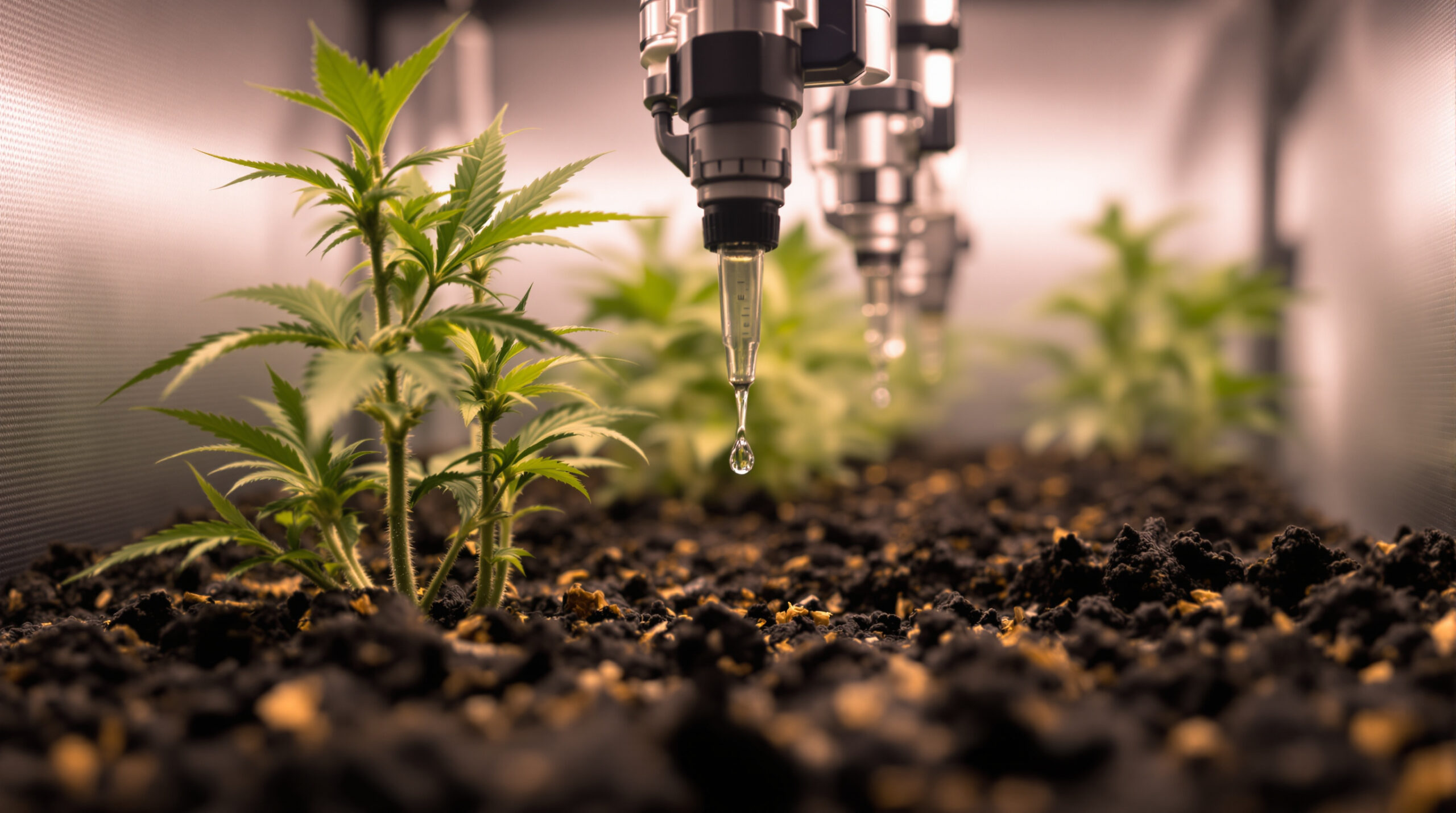
In professional facilities, lighting rarely determines the harvest—rather, it’s the question of whether each plant receives the same amount of nutrient solution at the right time. Irrigation is the most underestimated control lever in indoor cultivation, and simultaneously the only one that can be fully automated. What needs to happen technically, what research tells us, and where the line lies between expert knowledge and manufacturer promises.
📑 Inhaltsverzeichnis
- What Sets Fertigation Apart from Watering
- EC and pH: The Two Numbers Everything Depends On
- Uniformity: Why the Drip Emitter Determines Success
- Crop Steering: Irrigation as a Control Tool
- What an Automated System Needs Technically
- How a Professional System is Structured
- What’s Worth It for Whom
- 💬 Fragen? Frag den Hanf-Buddy!
Hobbyists water with a can and intuition. Those running a production facility cannot afford that: with several hundred plants, the uniformity of nutrient supply determines whether the final harvest is consistent or varies in ways that can neither be planned nor certified. This is precisely where fertigation comes in—the combination of irrigation and fertilization in a single, controlled process.
What Sets Fertigation Apart from Watering
In conventional watering, water is applied and fertilizer is added occasionally. With fertigation, the fertilizer is a permanent component of the water at a defined concentration that remains identical with each irrigation cycle. The plant receives not water and nutrients alternately, but a consistent nutrient solution.


The practical advantage lies in controllability. If you know the concentration and measure the amount dispensed, you know how much nutrient each plant has received. Working with a watering can means guessing. In research on soilless culture systems, this relationship is well documented; an overview of nutrient solution management and recirculation is provided, for example, in Voogt’s compilation in the standard work Soilless Culture (DOI: 10.1016/b978-0-444-63696-6.00010-4).
How differently substrate selection can vary is something we’ve calculated elsewhere, as discussed in the article Living Soil, Hydroponics or Rock Wool and in the comparison Living Soil versus Hydroponics.
EC and pH: The Two Numbers Everything Depends On
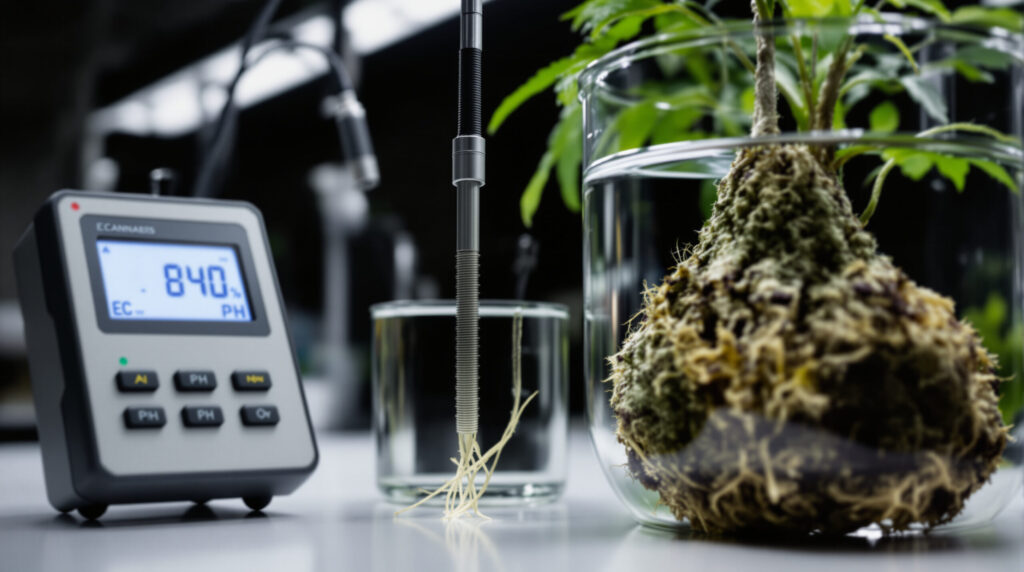
Two measured values determine whether a nutrient solution works. The EC value describes electrical conductivity and thus indirectly the total amount of dissolved salts. It indicates how concentrated the solution is, but not what it contains. The pH value determines which of the nutrients present the plant can actually absorb.
The second point is regularly underestimated. A nutrient can be present in sufficient quantity and still be unavailable because the pH value converts it into a form that the root cannot absorb. This is why adding more fertilizer when deficiency symptoms appear often does nothing, as long as the pH value is wrong. We’ve covered this for beginners in the article pH and EC Value for Seedlings.
In practice, it’s not enough to set both values once. Both values change in the tank over time, and they change even more dramatically in the substrate because the plant selectively absorbs: it pulls certain ions out faster than others, which shifts the composition of what remains. A rising EC value in the runoff is therefore not a measurement error, but information we’ve explained in the article Why Does the EC Value Rise in Drain Water?
This means for facility planning: measurement alone is not enough; you need regulation. Models for formulating nutrient solutions with defined target conductivity are the subject of dedicated research, such as by Moreira Barradas and colleagues in Irrigation Science (DOI: 10.1007/s00271-018-0569-9).
Uniformity: Why the Drip Emitter Determines Success
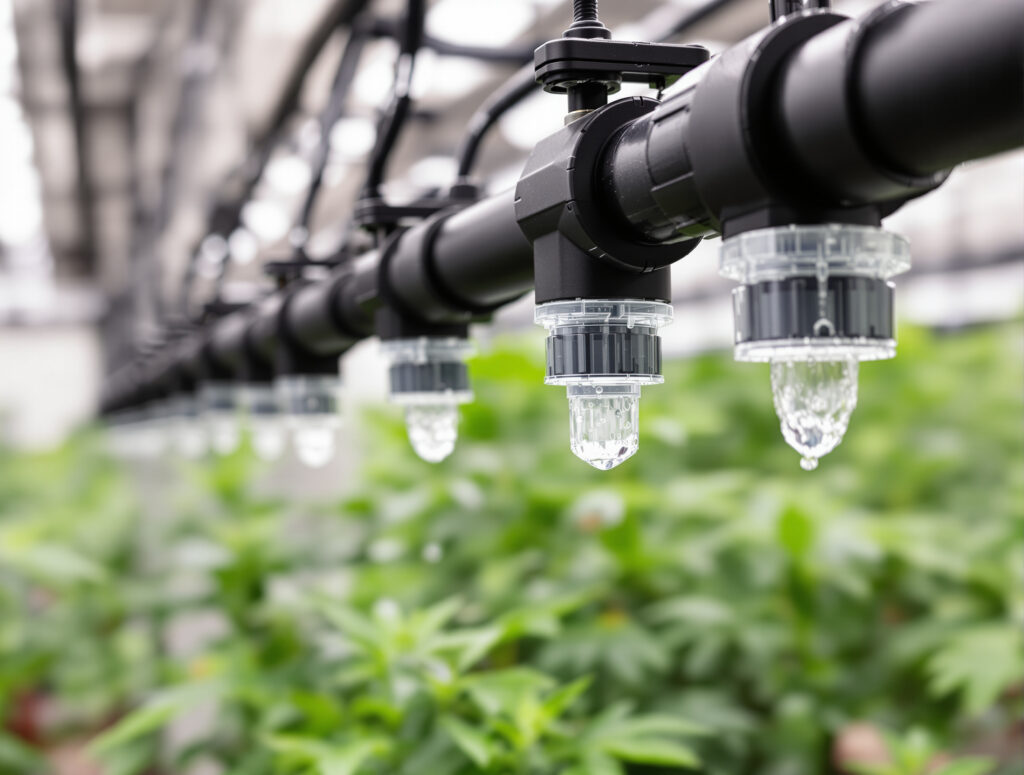
Even the best nutrient solution is of little use if distributed unevenly. Pressure drops along the length of an irrigation line. Without countermeasures, the first plant receives more than the last, and this happens continuously, every day, throughout the entire cycle.
The technical answer is pressure-compensating drip emitters. They contain an elastic membrane that deforms as pressure rises and narrows the flow cross-section, so the dispensed amount remains constant over a defined pressure range. The function and interaction of membrane and flow are well studied metrologically, among others by Chen and colleagues in Irrigation and Drainage (DOI: 10.1002/ird.2601). The key parameter is the flow exponent: the closer it is to zero, the more independent the dispensed amount is from pressure (DOI: 10.1002/ird.1929).
In practice, this means: pressure-compensating drip emitters are the difference between a facility that delivers predictably and one where position in the room determines the outcome. They cost more than simple drippers, and they’re the point where saving money comes back to haunt you fastest.
Crop Steering: Irrigation as a Control Tool
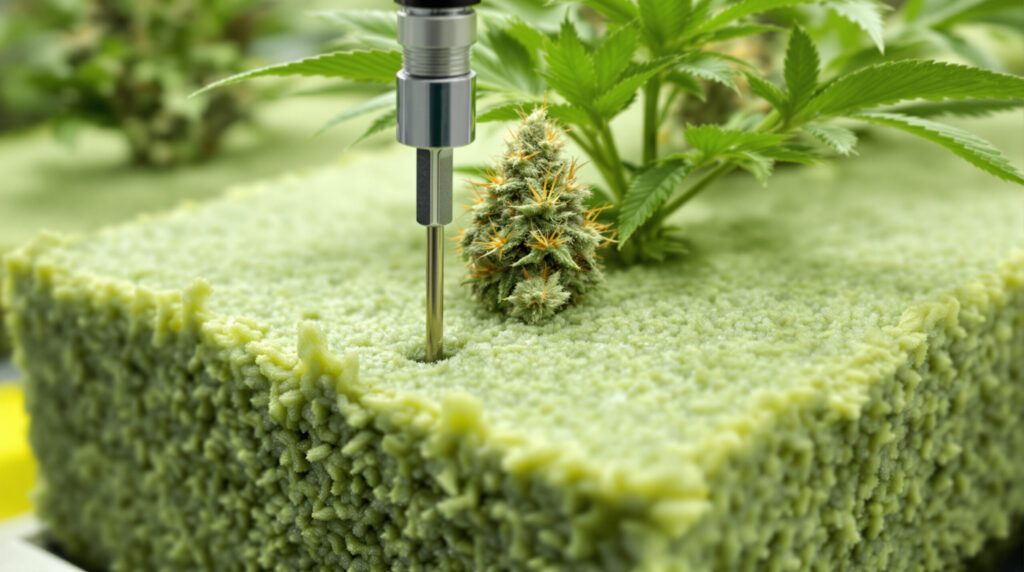
The most interesting part is not the nutrient supply, but deliberate undersupply. Under the term crop steering, the irrigation pattern throughout the day is divided into phases that pursue different objectives: ramping up after light begins, a maintenance phase, and controlled substrate drying toward the end of the light period, the so-called dry-back.
Behind this lies documented plant physiological observation. Controlled dry stress can increase the concentration of secondary compounds in plants that produce essential oils. For cannabis, Caplan and colleagues investigated this in 2019 in HortScience and measured higher cannabinoid levels in flower material under a defined dry stress regime (DOI: 10.21273/hortsci13510-18). More recent work examines the influence of nutrient regime and fertigation system on biomass and cannabinoid content together, such as Velechovský and colleagues in 2024 in Frontiers in Plant Science (DOI: 10.3389/fpls.2024.1322824).
The key qualification is: controlled dry stress means controlled. The difference between a stimulus that encourages the plant to produce compounds and damage that costs yield is a matter of measured values, not intuition. This is precisely why this method cannot be meaningfully implemented without substrate sensors. Volumetric water content is measured, usually together with conductivity and temperature, directly in the root zone.
Those who operate without these measurements and still run dry-back phases are not doing crop steering—they’re risking desiccation damage. This is where an expert procedure quickly becomes an expensive mistake.
What an Automated System Needs Technically
Regardless of manufacturer, a fertigation system consists of the same building blocks that must be coordinated with one another.
- Water treatment and storage. A tank buffers volume and temperature. Applying cold tap water directly to roots is an avoidable stress factor. Where water quality fluctuates, reverse osmosis precedes it to bring the starting EC to a defined value.
- Level monitoring and safeguards. Automatic filling requires a failsafe backup. A valve that closes automatically during power loss prevents water damage; a dry-run protection prevents pump damage.
- Dosing. Nutrient components must remain separate until diluted. If concentrates are brought together directly, calcium and sulfate or phosphate precipitate as poorly soluble compounds, and what precipitates is no longer available to the plant and can clog emitters in the worst case. This is why fertilizers exist in separate components A and B.
- Pressure generation. The pump must supply the pressure at which the emitters used operate. Variable-speed pumps maintain this pressure regardless of how many zones are currently open.
- Zoning. Rooms, varieties, and growth stages have different requirements. Separately switchable zones are the prerequisite for being able to irrigate differently at all.
- Control and logging. For regulated production, it matters not only that irrigation happened, but that it’s documented.
How a Professional System is Structured
What this looks like in a commercially available system can be understood through a typical setup like those manufacturers of professional irrigation lines currently offer. The following information is based on product documentation and has not been metrologically verified by us.
Storage consists of a 1,000-liter IBC tank whose level is monitored by an ultrasonic sensor. Water inlet runs through a motorized ball valve with spring return that closes de-energized, closing automatically during power loss. A heating mat controls tank temperature; optionally, reverse osmosis with a buffer tank can be added upstream. Dosing is handled by multiple separate, magnetically switched pumps configurable in milliliters per liter per component, with EC and pH checking before the irrigation pulse. Pressure is supplied by a variable-speed pump, controlled via a programmable logic controller with web interface. For crop steering, substrate sensors are provided that record volumetric water content, conductivity, and temperature.
What’s interesting about this setup is less the individual component than the consistency with which safeguards are integrated: normally-closed valve, dry-run protection, leak detection. These are the points where DIY solutions typically fail, and they cost more in damages than the system itself.
What’s Worth It for Whom
Not every system needs every expansion stage, and the question cannot be answered in blanket terms. As a guide:
- Automatic tank filling with safeguards pays off early because it saves labor and a single prevented water damage already justifies the investment.
- Proportional dosing is worthwhile once larger quantities of nutrient solution are regularly prepared, because manual mixing is the most common source of error during operation.
- Substrate sensors and crop steering are an expansion stage for operations that already produce stably and want to optimize deliberately. Those still struggling with basic problems won’t solve them with more measurement technology.
Manufacturer statements on when which expansion stage becomes cost-effective are recommendations, not universal thresholds. They depend on labor costs, cycle frequency, and what an outage costs in the specific operation.
Note: This article is directed at commercial and cooperative operators. Large-scale cannabis cultivation in Germany is permitted exclusively for cultivation associations within the framework of the Cannabis Consumer Law and for licensed medical cannabis producers; private home cultivation is subject to significantly narrower limits. This article describes facility technology and is not product advice, legal advice, or a health or efficacy claim. Manufacturer specifications are marked as such and have not been metrologically verified by us.
Wie bewässerst du aktuell deine Pflanzen im Indoor-Anbau?
Sources: Caplan et al., HortScience 2019 (DOI: 10.21273/hortsci13510-18); Velechovský et al., Frontiers in Plant Science 2024 (DOI: 10.3389/fpls.2024.1322824); Chen et al., Irrigation and Drainage 2021 (DOI: 10.1002/ird.2601); Zhangzhong et al., Irrigation and Drainage 2015 (DOI: 10.1002/ird.1929); Moreira Barradas et al., Irrigation Science 2018 (DOI: 10.1007/s00271-018-0569-9); Voogt, Soilless Culture 2019 (DOI: 10.1016/b978-0-444-63696-6.00010-4); Product documentation from a manufacturer of professional irrigation technology, as of August 2026.








Branchen-Update
News, Analysen und Reportagen — mehrmals im Monat direkt in dein Postfach.
Folge uns