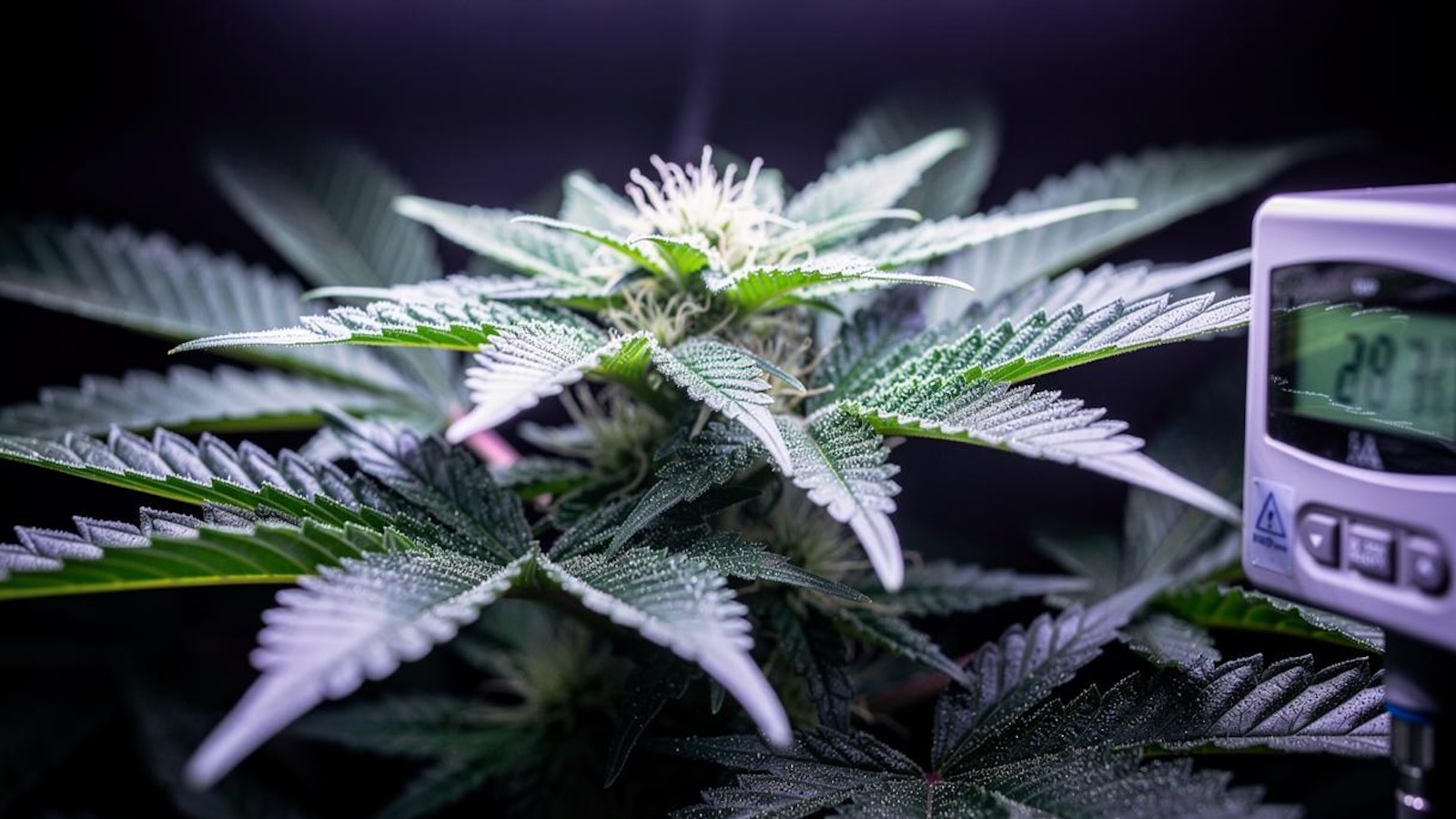
Daily Light Integral, or DLI, is the most important metric for cannabis lighting and simultaneously the most overlooked in grow literature. Growers who understand DLI stop thinking in watts and start thinking in photons. Here’s what you need to know about the measurement that determines whether your plants reach their genetic yield potential.
📑 Inhaltsverzeichnis
What DLI Means
DLI stands for Daily Light Integral and describes the total amount of photosynthetically active photons striking one square meter of plant surface over 24 hours. Unit: mol/m²/day. Calculation: PPFD (μmol/m²/s) multiplied by daily light duration in hours, multiplied by the factor 0.0036.
In other words: PPFD measures how bright the light is at any given moment. DLI sums that brightness across the entire day. This total—not the instantaneous peak—determines plant growth. A plant growing under 500 PPFD for 18 hours receives a DLI of 32.4 mol. A plant under 800 PPFD for 12 hours receives 34.5 mol—nearly identical, despite the second setup using stronger lights.


Cannabis DLI Ranges
Eaves et al. (2020) systematically studied how yield and quality depend on DLI in commercial cannabis production. The recommendations emerging from this and other research:
- Clones and seedlings: 5 to 15 mol/m²/day. Young plants burn easily; low light intensity is sufficient.
- Vegetative phase: 20 to 35 mol/m²/day. Rapid biomass growth; higher light translates directly to stronger growth.
- Early flowering: 35 to 50 mol/m²/day. Bud initiation and growth occur simultaneously; increased light maximizes bud formation.
- Late flowering: 45 to 65 mol/m²/day. Maximum yield potential, but only with adequate CO₂ and proper climate control. Above 65 mol, light bleaching occurs.
Why „Enough Watts“ Isn’t Enough
Watts only tell you about the lamp’s electricity consumption, not the light reaching your plants. A 600W LED can produce anywhere from 1,000 to 1,700 PPFD over one square meter of canopy, depending on efficiency, spectrum, and beam angle. Only the photons reaching the plant matter, measured with a PAR quantum sensor.
Without a sensor, reference manufacturer specifications. Reputable LED manufacturers include PPFD maps showing values at different mounting heights. With this data and your photoperiod, calculate DLI instantly using our DLI calculator.
What Happens With DLI Deviations
DLI too low: Plants stretch excessively (internodal spacing increases), photosynthesis runs below potential. Buds remain airy and fluffy; yields drop. Typical with underpowered lights or excessive distance.
DLI too high: Above 65 mol/m²/day in flowering, light bleaching appears—buds turn white and lose quality. Heat stress increases as well. CO₂ enrichment can shift the usable maximum upward (to roughly 80 mol with 1,200 ppm CO₂), but only with professional equipment.
Choosing the Right Photoperiod
During vegetation, more light hours equals more DLI, so 18 or even 20 hours of daily light makes sense. In flowering, the mandatory 12/12 photoperiod for flower initiation forces you to deliver as much light as possible in 12 hours. Here, PPFD becomes critical: 600 to 1,000 μmol/m²/s throughout the entire period.
Frequently Asked Questions
How do I measure PPFD without a professional sensor?
Quantum sensors like the Apogee MQ-500 are the gold standard but cost $400+ USD. Smartphone apps using built-in light sensors are imprecise (typically ±30%), but sufficient for trends. Alternatively, rely on manufacturer PPFD data.
How does DLI relate to YPF and PAR?
YPF (Yield Photon Flux) weights photons by their photosynthetic effect; PPFD counts them equally regardless of spectrum. For modern full-spectrum LEDs, the difference is minimal. Older HPS lamps tend to be slightly overrated in pure PPFD measurement.
Is CO₂ enrichment worth it for higher DLI?
For home growers, usually not—equipment is expensive and most rooms aren’t properly sealed. For commercial operations running DLI above 50 mol, CO₂ enrichment can boost yields by an additional 15 to 25 percent.
Does higher DLI increase THC content?
According to Eaves et al. (2020): higher DLI values produce larger total harvests, but the relative THC percentage of buds remains relatively stable. More light means more buds, not stronger buds.
Scientific sources: Faust JE & Logan J (2018) on DLI methodology · Eaves J et al. (2020) on cannabis light-yield relationships · Chandra S et al. (2017) on cultivation methodology.


Wie steuerst du aktuell die Beleuchtung deiner Pflanzen?
Branchen-Update
News, Analysen und Reportagen — mehrmals im Monat direkt in dein Postfach.
Folge uns