When growing from regular seeds, growers eventually face the most critical decision of the entire cultivation: is this plant male or female? Identifying male cannabis is crucial to determining whether you’ll harvest resinous, seedless flowers or watch half your crop turn into seeds. The good news is that with patience and a trained eye, you can reliably identify the sex long before actual flowering begins.
📑 Inhaltsverzeichnis
Why plant sex determines harvest quality
Cannabis is a dioecious plant, meaning male and female flowers typically grow on separate individuals. For consumption purposes, only female plants matter, because they alone produce the dense, cannabinoid-rich flower clusters. An unfertilized female plant dedicates all its energy to resin and aroma production instead of seed development. This principle underlies the term sinsemilla—seedless flower material with high cannabinoid content.
An overlooked male plant can destroy this plan. Once its pollen sacs burst, fine pollen spreads throughout the space with the slightest air movement. Nearby female plants respond by producing seeds and simultaneously reducing resin production. The result is airy, seed-filled flowers with noticeably lower quality. Those seeking to understand plant fundamentals will find helpful background in our overview of the natural life cycle of cannabis.


When sex becomes visible: the preflower stage
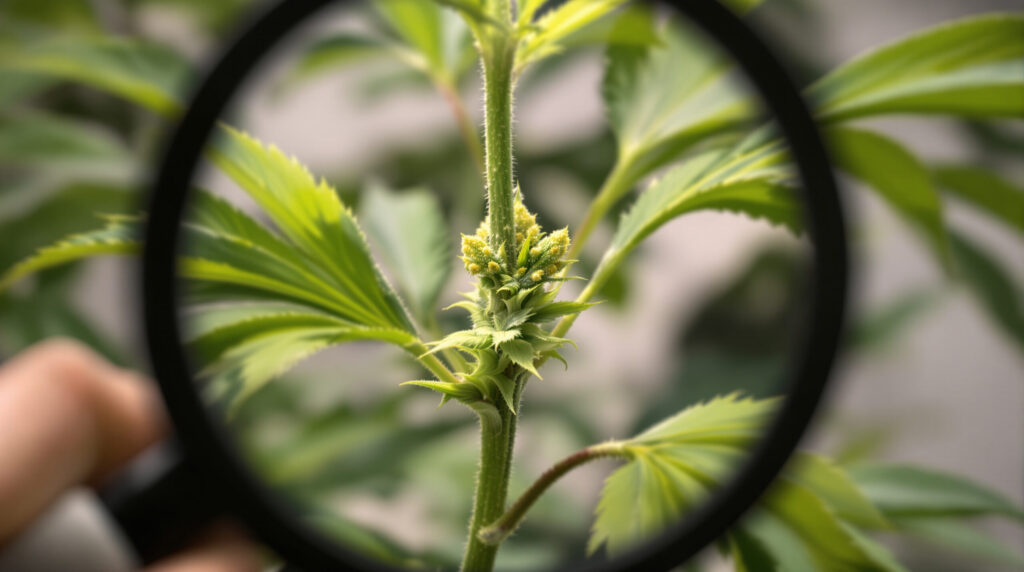
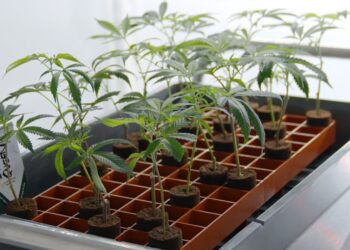
Plant sex cannot be determined from the seedling stage but only becomes apparent during preflowering. This phase typically begins four to six weeks after germination in most strains, when the plant transitions from pure vegetative growth to flower preparation. Male plants are often somewhat faster, displaying their first sex characteristics several days to weeks before females, and in outdoor cultivation sometimes many weeks earlier.
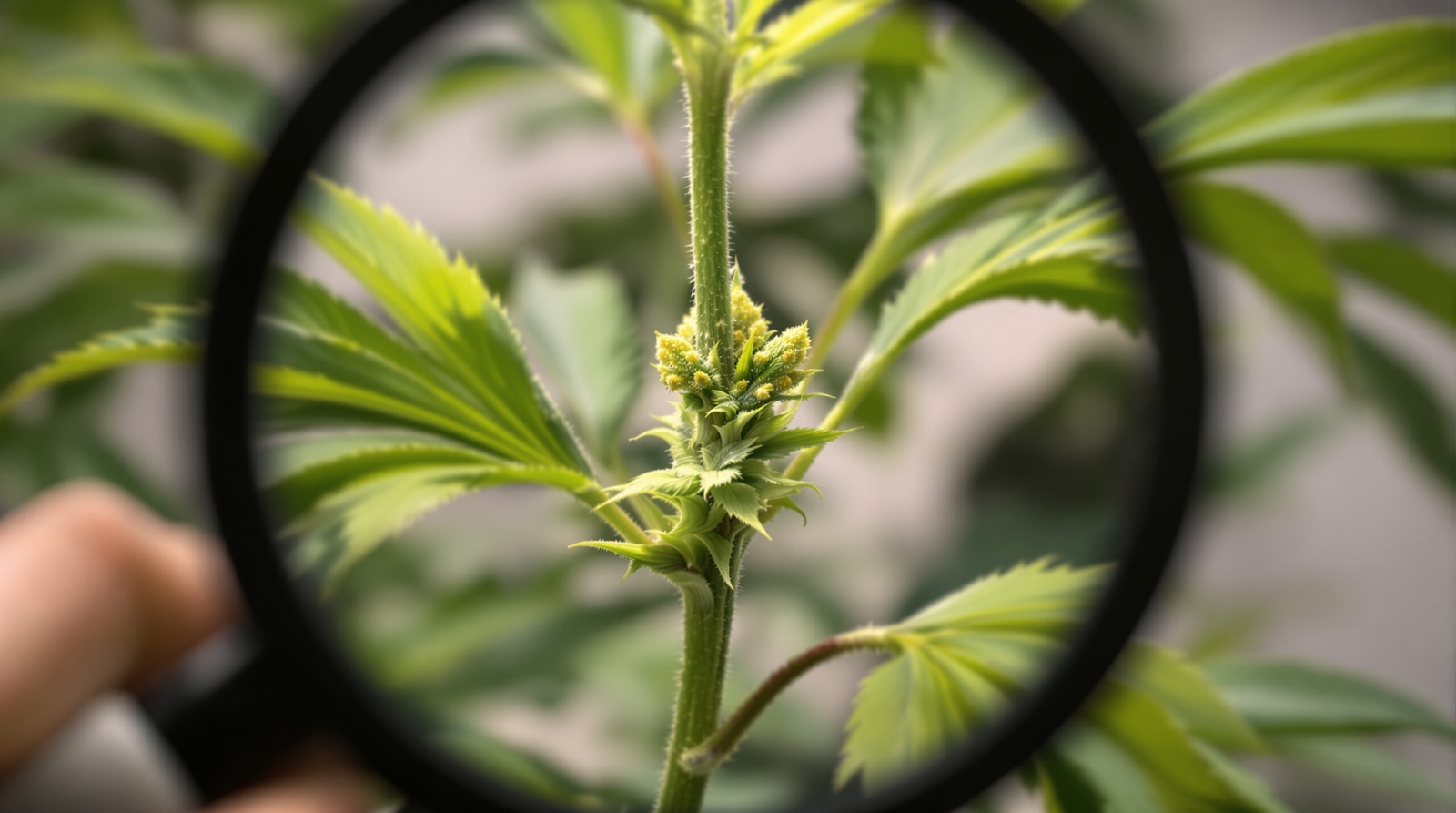
The critical observation points are the nodes—the branch junctures where petioles and lateral shoots emerge from the main stem. The tiny structures revealing plant sex form precisely here. A magnifying glass or simple pocket microscope with ten to thirty times magnification is enormously helpful at this stage, since preflowers are initially barely larger than a pinhead. Growers who examine their plants closely daily develop an eye for fine details, including learning why some cannabis plants turn purple.
Identifying male preflowers: the pollen sacs
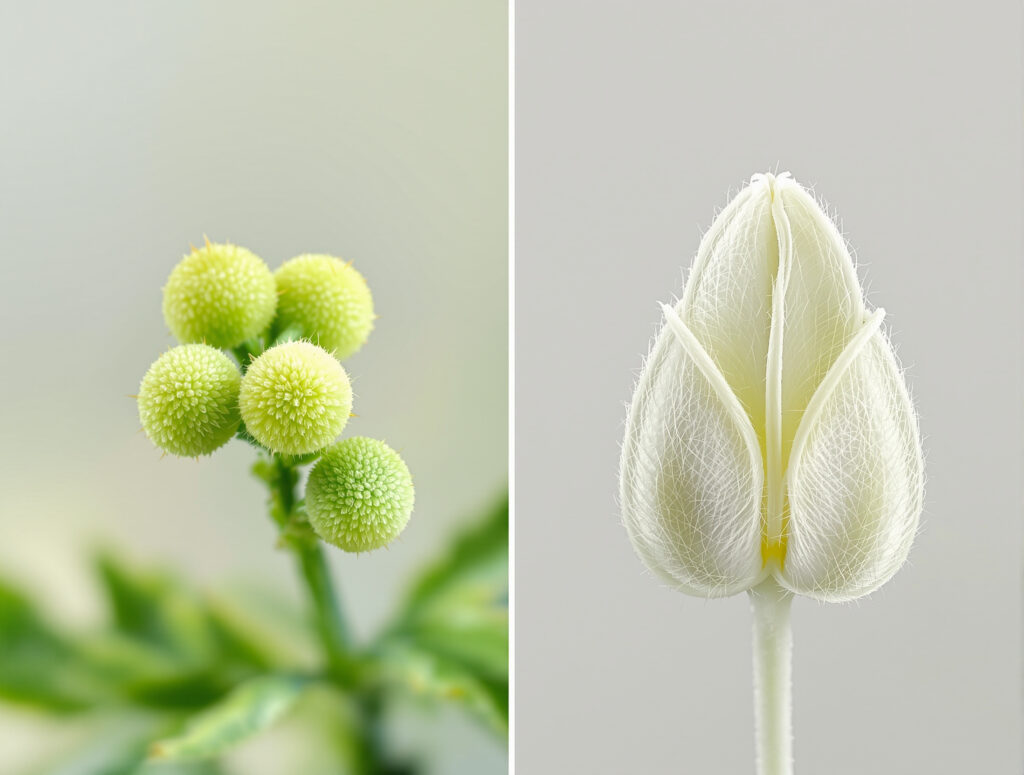
The most reliable indicator of a male plant is the pollen sacs. They appear at the nodes as small, smooth spheres arranged individually or in tiny clusters and bunches. Their shape resembles miniature balls or a spade symbol on a playing card. The key distinguishing feature is their surface: male preflowers are completely smooth and never bear fine white hairs.
Female preflowers look distinctly different. They form more teardrop or pear-shaped calyxes from which two delicate white hairs protrude, often forming a V shape. These hairs are the pistils where the flower will eventually develop. This yields a simple daily rule for the grow room: no hairs means male, white hairs mean female. We explore these distinctions in depth in our guide to sex determination in cannabis plants.
In their early days, pollen sacs remain tightly sealed with immature pollen inside. When they shift from green to pale yellow or brown, the pollen within ripens. By this point, action is essential, because the sacs will split open shortly thereafter and release their contents. A single burst pollen sac in a room full of blooming females virtually guarantees a seeded harvest.
Male, female, or hermaphrodite?
A third possibility causes confusion among many growers: the hermaphrodite plant. Such plants produce both male and female flower characteristics simultaneously, bearing both pollen sacs and hair-crowned calyxes. Often they also display so-called bananas—yellowish stamens growing directly from otherwise female flowers.
Hermaphroditism is typically a stress response and survival strategy. Common triggers include light leaks during the dark period, extreme temperature fluctuations, disrupted light cycles, or severe nutrient deficiency. Certain genetics are also more prone to it than others. The insidious aspect is that a single hermaphrodite plant can pollinate an entire crop. Therefore, hermaphrodites require the same caution as pure males—often even greater attention, since pollen sacs nestled among female flowers easily go unnoticed.
What to do with male plants?
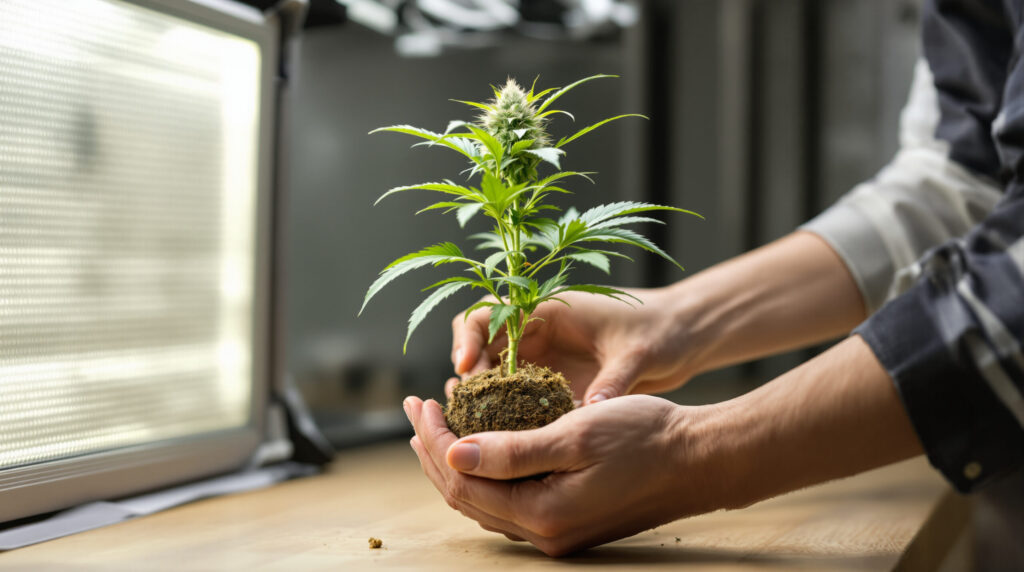
For most home growers focused on flower quality, the answer is simple: remove them. Proper handling is important. An identified male should be removed as early as possible, while pollen sacs remain closed. Remove it with slow, deliberate movements without sudden motions that might release pollen. Some growers slightly dampen the soil beforehand, since moisture binds airborne pollen. Ideally, handle the plant outside the grow room.
Discarding a male isn’t mandatory. For intentional breeding, males are actually essential, as only their pollen enables new crosses and generation of stable seeds for future cycles. Pollen from a promising male can be collected, dried, and stored cool for weeks. Additionally, stems, leaves, and fibers from male plants provide material for extracts, tea, or compost. Using feminized seeds substantially reduces the risk of males from the start, but regular preflower monitoring remains prudent regardless.
Tools and tricks for early sex determination
Those unwilling to wait weeks have several options for earlier, more reliable sex identification. The simplest tool is a quality magnifying glass or small pocket microscope. Since initial preflowers are barely larger than a pinhead, magnification often determines whether you can distinguish a smooth pollen sac from a hairy female calyx. A bright, focused light source additionally helps by making the fine hairs of female preflowers visible.
Impatient growers also employ the so-called forcing technique. A single lower branch is cut, rooted, and placed in a separate area under twelve hours of light and twelve hours of darkness. The cutting responds to the short photoperiod and begins flowering within days, allowing growers to determine the mother plant’s sex without forcing the entire crop to flower. Alternatively, laboratory genetic tests can determine sex at the seedling stage. For home cultivation, however, patient daily monitoring of nodes during preflowering remains the cheapest and most reliable method.
Consistency matters with all methods. During this critical phase, daily visual inspection pays off, since a male can progress from inconspicuous buds to mature, bursting pollen sacs within days. Missing this narrow window risks the very pollination you aimed to prevent.
Frequently asked questions
When can male cannabis be identified?
First sex characteristics typically appear during preflowering, roughly four to six weeks after germination. Male plants often show up somewhat earlier than females, developing pollen sacs sometimes days to weeks before female preflowers appear.
How can I reliably identify a male plant?
The clearest indicator is the small, smooth, spherical pollen sacs at the nodes. They’re often clustered together and never bear white hairs. Female preflowers, by contrast, display two fine white hairs. The rule of thumb: no hairs means male, hairs mean female.
What happens if a male plant remains in the grow room?
When pollen sacs mature, they burst and pollinate surrounding female plants. These then redirect energy toward seed production instead of resin. The result is seeded, less potent, and airier flowers. A single overlooked male can compromise an entire harvest.
Can male plants be used productively?
Yes. For breeding they’re indispensable, since only their pollen enables new crosses and homegrown seed production. Pollen can be collected and stored cool. Additionally, stems, leaves, and fibers suit extraction, tea, or compost.
What is a hermaphrodite plant and how dangerous is it?
Hast du schon einmal männliche Hanfpflanzen zu spät erkannt?
A hermaphrodite simultaneously produces male pollen sacs and female flowers, usually as a stress response to light leaks, temperature swings, or nutrient deficiency. Since a single hermaphrodite can pollinate an entire crop, it poses similar risk as a pure male and warrants equally vigilant monitoring.





Branchen-Update
News, Analysen und Reportagen — mehrmals im Monat direkt in dein Postfach.
Folge uns