

A systematic review from Universidad de Chile published in the journal Frontiers in Veterinary Science concludes that cannabidiol demonstrates consistent antiproliferative and pro-apoptotic effects in canine tumor cell lines. The review, appearing in May 2026, synthesizes preclinical evidence from lymphoma, mammary carcinoma, glioma, prostate carcinoma, osteosarcoma, and urothelial carcinoma. Authors Francisca J. Medina and Cristian G. Torres from the Faculty of Veterinary Medicine and Animal Sciences at Universidad de Chile identify substantial potential for clinical veterinary oncology while pointing out methodological limitations in the existing body of research.
📑 Inhaltsverzeichnis
The systematic review follows PRISMA standards and evaluates studies published between 2015 and 2025 in PubMed, Scopus, and Web of Science. Only studies using canine cell lines or dogs as model organisms were included. The key takeaway for practitioners is that CBD demonstrated antitumor effects across nearly all examined tumor entities, though clinical applicability still depends on well-controlled veterinary studies.
Mechanisms of Action Overview

Cannabidiol exerts its antitumor activity through multiple parallel signaling pathways. In the examined canine cancer cells, the substance induces apoptosis by activating caspases 3, 8, and 9, as well as through mitochondrial release of cytochrome c. Simultaneously, CBD inhibits cell migration by reducing matrix metalloproteinases MMP-2 and MMP-9. In lymphoma cells, modulation of the MAPK signaling cascade leads to autophagic cell elimination. The authors emphasize that these mechanisms operate largely independently of the CB1 cannabinoid receptor, explaining the absence of psychotropic effects and making the substance particularly attractive for veterinary medical applications.


Medina and Torres give special attention to osteosarcoma, an aggressive bone cancer form common in large dog breeds. Cell culture studies here demonstrated dose-dependent reduction in tumor cell viability, with effective concentrations ranging between 10 and 20 micromoles per liter. Similar effects are documented for canine mammary carcinomas, which represent one of the most frequent tumor entities in unspayed bitches. For a comprehensive introduction to veterinary cannabinoid applications, see our overview article on cannabis use in veterinary medicine.
Safety Profile in Dogs
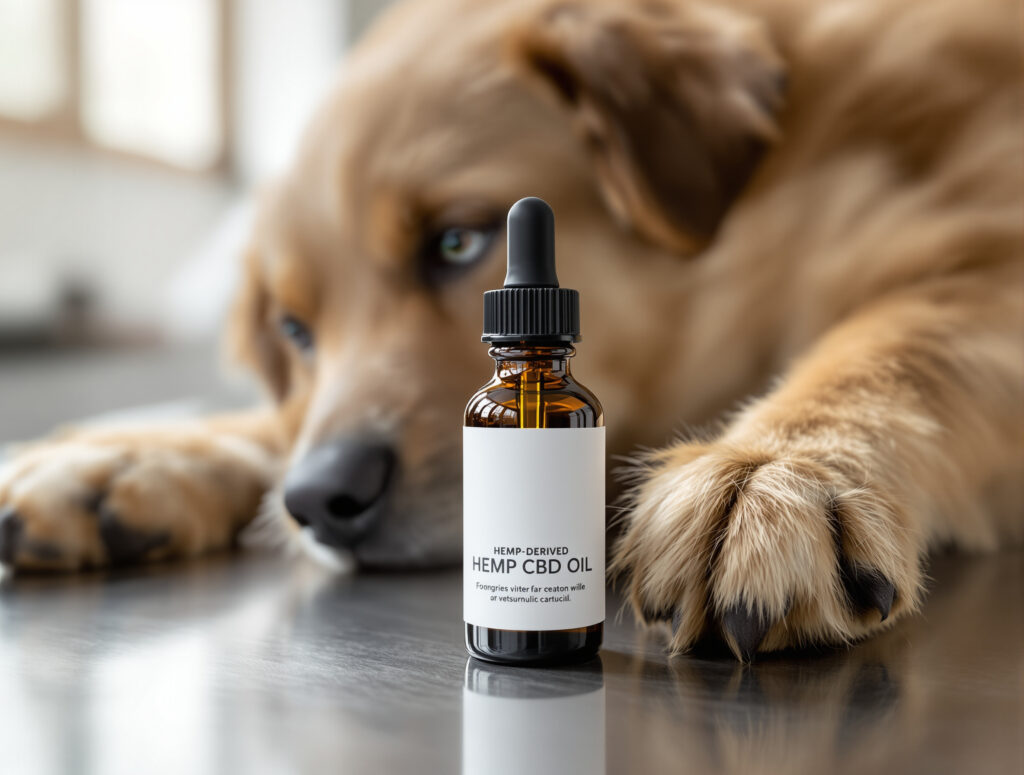
A central point of the review is CBD’s documented tolerability in dogs. Studies from 2019 and 2023 show that oral dosages of two to four milligrams per kilogram of body weight typically cause no clinically relevant adverse effects. At higher doses, occasional transient elevations in alkaline phosphatase and mild diarrhea occur. Bioavailability is four to five times higher when administered with fatty food compared to fasting. These pharmacokinetic data support clinical applicability, although optimal oncological dosing has not yet been defined.
The authors place their findings within a broader trend. An earlier overview of cannabis cancer therapy in pets had already shown similar tendencies in 2023. What is novel about the Universidad de Chile review is its systematic methodological assessment. Of 142 initially identified studies, only 18 remained after applying inclusion and exclusion criteria, of which just three comprise prospective clinical studies in diseased dogs. The remaining studies work with cell lines or mouse models with transplanted canine tumors.
Methodological Limitations and Open Questions
Medina and Torres openly name the methodological limitations. Most studies work with full-spectrum extracts of varying composition, making comparisons between individual studies difficult. Standardized CBD concentrations, validated endpoints, and uniform tumor classifications are largely absent. Combination with classical chemotherapeutics has been systematically examined in only two studies. The authors call for multicenter clinical trials with larger canine populations, uniform diagnostic criteria, and defined pharmacokinetic companion analyses.
For pet owners and veterinarians, the review offers cautious encouragement but no treatment recommendation. CBD could be considered in oncological treatment schemes as a supportive measure—for instance, for pain relief, appetite stimulation, or stress reduction in conjunction with chemotherapy. Sole application as a curative cancer therapy is not justified by the current evidence base. Anyone considering complementary cannabinoid therapy for their pet should discuss it with their veterinarian, ideally involving a veterinary oncology specialist facility.
Clinical Applications and Dosing
In the examined studies, clinical dosages typically range from two to five milligrams of CBD per kilogram of body weight daily, administered as an oral oil with fatty food. This enhances bioavailability significantly. In cell culture studies, concentrations between 5 and 30 micromoles per liter were employed. These laboratory values cannot be directly translated to oral doses, as bioavailability and tissue distribution must be considered.
Frequently Asked Questions
Can I simply give my cancer-stricken dog CBD oil from a health food store?
This is not advisable without veterinary supervision. Food-grade CBD products are not subject to pharmaceutical quality control, and their cannabidiol content sometimes fluctuates considerably. Additionally, interactions may occur with ongoing therapies such as chemotherapy drugs or pain medications. Always discuss treatment with your veterinarian and ideally consult a specialist with veterinary oncology experience.
Which cancer types show the clearest effects in the review?
The strongest preclinical evidence exists for canine lymphoma and osteosarcoma. In both tumor entities, multiple independent studies document dose-dependent inhibition of tumor cell proliferation and increased apoptosis rates. For glioma and urothelial carcinoma, the data base is smaller but tends to be consistent. Mammary carcinoma and prostate carcinoma also show effects, though the number of studies is still too small to draw robust conclusions.
Are there clinical studies on real patients, not just cell cultures?
Yes, but they remain rare. The Universidad de Chile review identifies three prospective clinical studies with diseased dogs. The largest comprises 28 animals and examines CBD as adjunctive therapy in lymphoma patients. The methodological quality of these studies is heterogeneous, and case numbers are small. Multicenter Phase 2 studies are in preparation, with concrete results expected earliest in 2027.
What dosages are used in research?
In clinical studies, dosages typically range from two to five milligrams of CBD per kilogram of body weight daily, administered as an oral oil with fatty food. In cell cultures, concentrations between 5 and 30 micromoles per liter were used. These laboratory values cannot be directly applied to oral dosing, as bioavailability and tissue distribution must be considered.
Does THC have a similar effect to CBD?
Some included studies test THC-containing full-spectrum extracts and occasionally find even stronger antitumor effects. However, THC is toxic to dogs because they are particularly sensitive to its psychotropic properties. The review therefore clearly recommends focusing on CBD-dominant preparations in clinical application, if cannabinoids are used at all.
Hast du schon Erfahrung mit CBD für Haustiere gemacht?
Sources: Medina FJ, Torres CG. Antitumor Effects (Potential) of Cannabidiol (CBD) in Canine Oncology: A Systematic Review. Frontiers in Veterinary Science, Vol. 13, 2026; Marijuana Moment 15.05.2026; Universidad de Chile, Faculty of Veterinary Sciences and Animal Sciences.






Branchen-Update
News, Analysen und Reportagen — mehrmals im Monat direkt in dein Postfach.
Folge uns