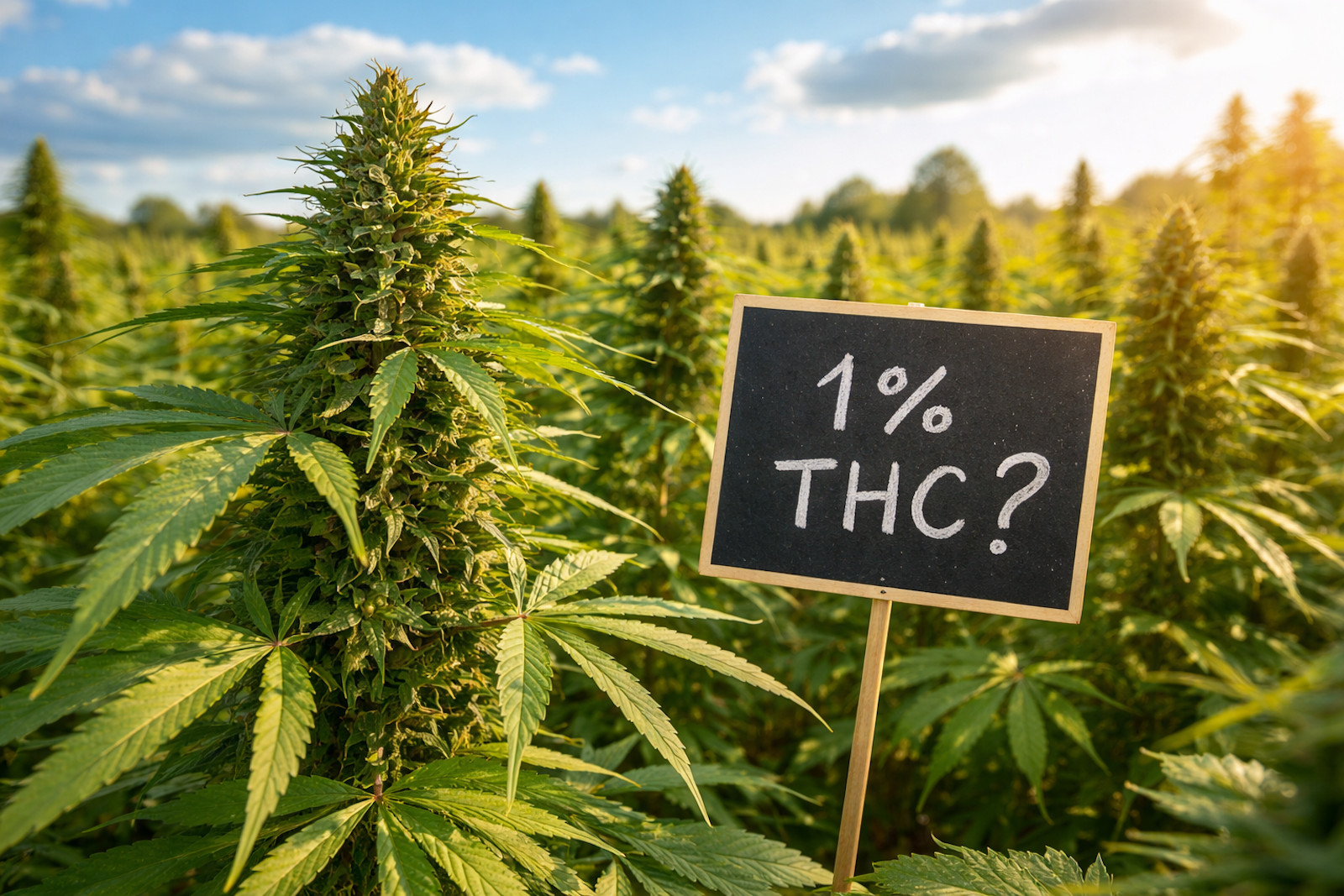
Industrial hemp is experiencing a remarkable renaissance in Germany. What long stood as a niche practice is increasingly moving into the spotlight of agriculture, industry, and politics. The catalyst is a debate with the potential to reshape the entire sector: the possible increase of the permitted THC threshold from the current 0.3% to as high as 1%. For many stakeholders, this would be far more than a technical adjustment—it would represent a paradigm shift.
📑 Inhaltsverzeichnis
A Threshold with Far-Reaching Consequences
The currently applicable 0.3% THC limit defines which varieties can be legally cultivated as industrial hemp in Germany. While this appears clear on paper, practice tells a different story. The THC content of a plant naturally fluctuates, influenced by weather, soil conditions, stress factors, and harvest timing. Even minor deviations can place farmers in a legal gray zone—with potentially severe consequences.
Many operations have reported persistent uncertainty for years. Fields risk destruction if THC levels exceed limits, subsidies hang in the balance, and legal disputes are commonplace. The discussion around a 1% threshold is therefore fundamentally about planning security and economic viability.


Why 1% Wouldn’t Be a Radical Step
From an international perspective, raising the limit would hardly be unprecedented. Countries like Switzerland have long permitted THC content up to 1% in industrial hemp—without apparent negative effects on public safety or misuse. Italy similarly maintained a higher tolerance threshold that gave the industry more flexibility.
Proponents argue that even at 1%, no intoxicating effects would be expected. The distinction between industrial hemp and psychoactive varieties remains clear and observable. Simultaneously, the increase would enable access to more robust seed stock better adapted to climate change and capable of delivering higher yields.
Momentum for Agriculture and Industry
For farmers, the new threshold could represent genuine relief. Greater variety diversity means better adaptation to regional conditions, reduced harvest risks, and more efficient utilization of the entire plant. This directly impacts economic viability—a decisive factor in an era of rising production costs.
Processing industries are also watching the political debate closely. Hemp applications have long exceeded fiber production, now extending to building materials, textiles, composite materials, insulation products, and bio-based plastics. A more stable raw material base would facilitate investment and accelerate innovation. For Germany as an industrial hub, this is an aspect not to be underestimated.
Political Caution and Outdated Reflexes
Despite economic arguments, the proposal faces resistance. Critical voices warn of blurred boundaries and additional burdens on regulatory authorities. Often these concerns stem less from scientific evidence than from political caution and ingrained prejudices about the plant.
Yet change is becoming visible here too. Increasingly, policy specialists, industry associations, and agricultural organizations openly advocate for reform. They point to studies, international experience, and the necessity of freeing industrial hemp from its legal special status.
Germany at a Crossroads: Caution or Opportunity?
The 1% debate is symptomatic of Germany’s overall approach to hemp. On one side stands the desire for control and clear regulations; on the other, recognition that excessive restrictions stifle innovation. While other countries modernize their frameworks, Germany risks falling behind.
Simultaneously, political pressure is mounting. Expanding sustainable agriculture, reducing CO₂ emissions, and strengthening regional value chains are stated policy goals. Industrial hemp fits this agenda perfectly. Adjusting the THC threshold would be a comparatively simple step with substantial impact.
More Than Just a Number
Whether the threshold actually rises to 1% remains uncertain. What is clear is that momentum is building. The debate is no longer driven solely by industry but increasingly supported by scientific and economic arguments.
Ultimately, this involves more than a regulatory threshold. It asks whether Germany is ready to treat industrial hemp for what it truly is: a versatile, sustainable, and economically significant crop. The decision on the 1% limit could become a symbol of a new, more pragmatic approach—and the opening bell for genuine growth in the sector.



Branchen-Update
News, Analysen und Reportagen — mehrmals im Monat direkt in dein Postfach.
Folge uns