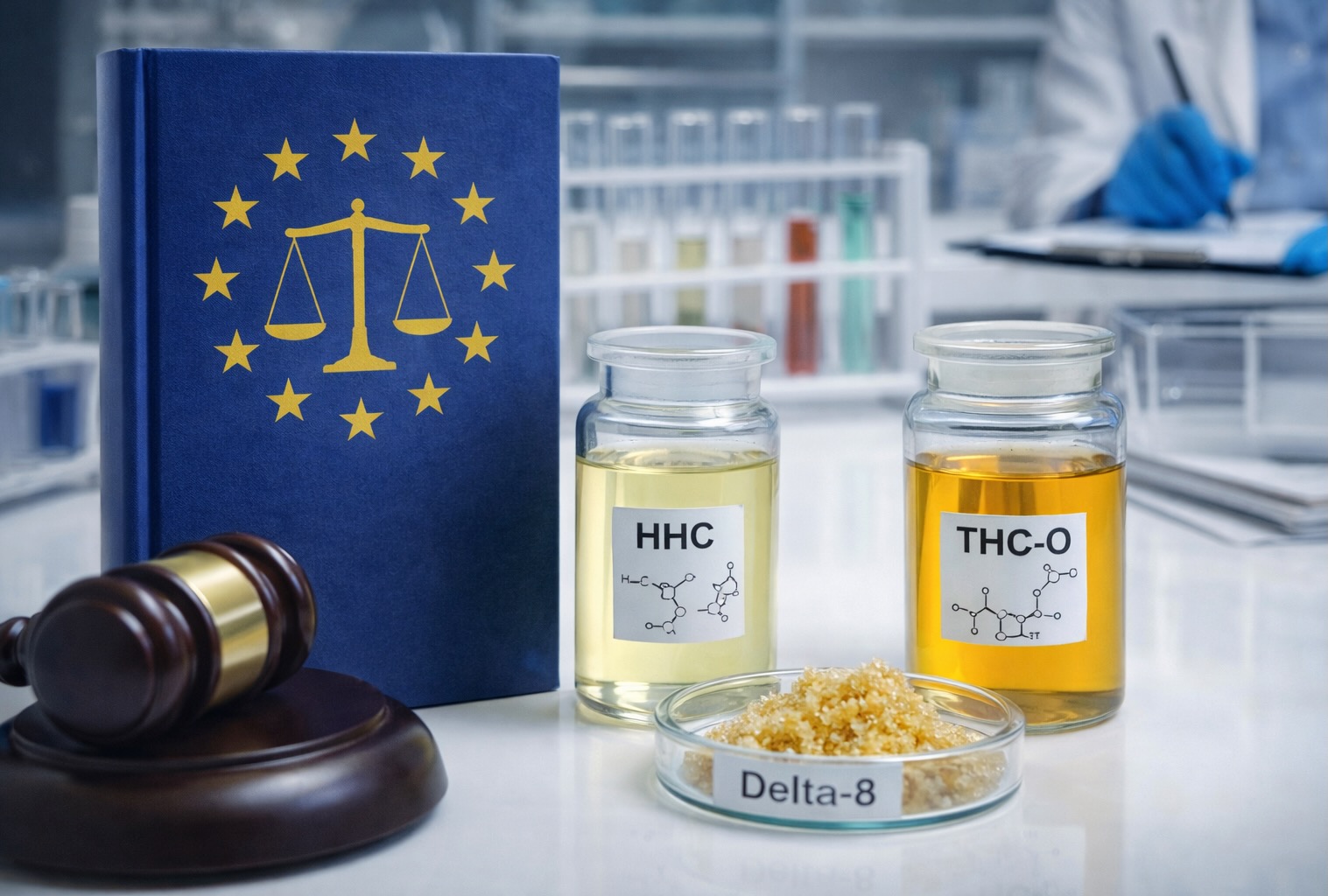
The European cannabis market is in a phase of rapid transformation. While traditional products are long established, new cannabinoids have been flooding the market for several years—substances that either occur naturally in very small quantities or are produced through chemical conversion of existing plant compounds. This development presents challenges for policymakers, authorities, and scientists alike. The market is moving faster than regulation, and existing laws are barely prepared for this dynamic.
📑 Inhaltsverzeichnis
New cannabinoids like Delta-8-THC, HHC, and other semi-synthetic derivatives initially appeared in legal gray zones. They were often marketed as „legal alternatives,“ particularly in countries with restrictive regulations on classic cannabis. In the meantime, a standalone market has developed that creates uncertainty across Europe—not only among consumers, but also among regulatory authorities.
Scientific Gaps and Open Questions
A central problem is the lack of reliable scientific data. For many of these new cannabinoids, neither comprehensive toxicological studies nor long-term investigations into their effects on the human body exist. The European Food Safety Authority (EFSA) recently pointed out that there are significant knowledge gaps—both regarding natural origin and health risks.


Particularly problematic is the distinction between natural and synthetically modified substances. While classical cannabinoids are extracted directly from the plant, many new variants are created through chemical isomerization or other processes. Legally, they often fall outside existing definitions anchored in drug or pharmaceutical law. For authorities, this means they must decide whether to regulate new substances individually or take a more fundamental approach.
National Solo Efforts Instead of European Consensus
Currently, Europe is responding primarily in a fragmented manner. Some countries have blanketly banned certain cannabinoids, while others rely on transitional regulations or tolerate sales as long as no explicit bans exist. These national solo efforts result in a patchwork of regulations that burdens the internal market and creates uncertainty for businesses and consumers alike.
For manufacturers and retailers, this means high risk. Products that are legal to sell in one country can suddenly be considered illegal in a neighboring state. This makes investment difficult and stifles innovation. At the same time, it becomes clear that bans alone don’t make the market disappear. Instead, supply often shifts into less transparent structures.
Regulation as a Brake or as a Framework?
The central question is not whether regulation should occur, but how. A purely repressive strategy risks stifling innovation and pushing the market into informal areas. At the same time, unregulated distribution is hardly responsible given the open scientific questions.
A possible solution would be clear, European framework legislation that doesn’t blanketly ban new cannabinoids but ties them to clear criteria. This could include mandatory safety assessments, transparent manufacturing processes, and clear labeling. Similar models already exist in the food and pharmaceutical sectors. They could be adapted for cannabinoids without fundamentally preventing innovation.
The Role of Industry
The industry itself also bears responsibility. In recent years, some market players have deliberately exploited legal gray zones to quickly place products on the market—often without sufficient consumer information. This approach has reinforced mistrust among policymakers and authorities.
At the same time, there are companies that rely on scientific support, laboratory analysis, and transparent communication. They themselves demand clear rules so they can plan long-term. For these actors, regulation is not an enemy but a prerequisite for sustainable growth. The challenge is to involve these voices more strongly in the political process.
Consumer Protection in a Field of Tension
From a consumer protection perspective, the current situation is unsatisfactory. Many consumers don’t know exactly what they’re buying, how the substances work, or what risks exist. Inconsistent product labels and lack of standards make informed decisions difficult.
A European solution could address this by establishing minimum standards for quality, purity, and information. This would not only increase safety but also strengthen confidence in the market. At the same time, unscrupulous providers could be more easily identified and excluded.
Where Is Europe Heading?
Europe stands at a crossroads. The debate over new cannabinoids is a symptom of a larger problem: existing cannabis regulation comes from a time when such products simply didn’t exist. Reality has overtaken these regulatory frameworks.
Whether Europe takes an innovation-friendly yet responsible path or loses itself in national bans will significantly determine the market’s future. One thing is clear: without a scientific foundation, without European coordination, and without dialogue with industry, the tension between regulation and innovation will only intensify.
The coming years will show whether Europe has the courage to view new cannabinoids not only as a risk, but also as an opportunity for modern, coherent cannabis policy.







Branchen-Update
News, Analysen und Reportagen — mehrmals im Monat direkt in dein Postfach.
Folge uns